On a childlike view of the world
Prelude
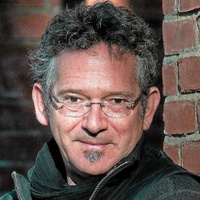
Natalie Musteata and Alexandre Singh are a filmmaking duo. Natalie is a Romanian-American writer, curator, and filmmaker, with a PhD in art history. Alexandre is a Franco-Indian visual artist whose work has been collected by the MoMA and Guggenheim Museum, New York, and CNAP, Paris. Their second short, Two People Exchanging Saliva, premiered at the Telluride Film Festival and is nominated for an Oscar and César Award for Best Live Action Short. They live and work in Brooklyn, New York.
Conversation
On a childlike view of the world
Directors Natalie Musteata and Alexandre Singh discuss a desire to play, not shying away from audacity, and film as catharsis.
As told to Reina Bonta, 1282 words.
Tags: Film, Collaboration, Success, Process.
Short films are, well, short. With a time limit inherent to the form, do you ever feel constrained in terms of story? How do you approach time in general, with the short film medium?
Alexandre Singh: There’s a temptation in a short film to accelerate the storytelling. But we often talk about the analogy of the film being like an accordion. There are moments and scenes where we’re drawing the accordion out. We’re taking a breath. We’re lingering on shots. And then we start to push the accordion in, and it starts to make music. And then we stop and breathe out again. For us, that rhythm is very important.
Natalie Musteata: A lot of people making shorts feel a certain amount of pressure to make a film that’s below 15 minutes because that’s the deadline of Cannes. Or below 20 minutes, because that’s the deadline of Venice. Our film runs 36 minutes. In the end, we just decided that it’s absurd to think about art in terms of minutes, and what was important for us was to tell this story in the amount of time that it required.
Do you think that all short films can and should be expanded into feature films? What do you think is the criteria for expansion into a longer piece?
Alexandre: In America, there’s this expectation that short films are always a stepping stone. They’re always a proof of concept. I think that’s unhealthy. We say that ironically…
Natalie: …as people who are about to make a short into a feature.
Alexandre: I think it would be nice if that was the exception rather than the rule.
Your most recent film, Two People Exchanging Saliva, is nominated for an Academy Award for Best Live Action Short Film. The film has had a lot of conventional success. How do you define success and failure?
Alexandre: Paradoxically, we’re in this age where streamers and media companies are looking for short-form content. Yet short films aren’t being disseminated that widely. And when they’re in film festivals with feature films, they’re always the children at the adults’ table.
Natalie: We didn’t shy away from audacity. We didn’t dull the edges of our ideas. But we had no idea whether people would connect. It came from a place of anger and bewilderment towards our own world, in terms of the normalization of violence, the absurdity of not being able to love the person that you want to love, and the fact that our civil liberties are constantly being taken away from us. So we made this really sincerely, and it did connect with audiences. For us, the relationship of the audience to the film was the measure of success. It’s one of the reasons why we distributed the film with The New Yorker. It’s not only a platform that we really respect and have loved for many, many years, but if we’re talking in technical terms, The New Yorker pays a lot less than other distributors. That being said, the reach is huge because their platform is basically YouTube. You’re opening up your film to anyone. And while that can be really scary, it’s also amazing to have the film so freely out there in the world.
How do you disentangle your own creative input and feelings from one another’s?
Natalie: The idea that a director should be one person feels in itself kind of absurd.
Alexandre: Yeah, making 50,000 decisions… We often talk about a film as being a form of clay. You can have an idea, but then you hit that idea over to your cinematographer and she says, “Oh, what about if we do that?” And then she pings it back to you and you say, “No, but how about this?”
Natalie: We’re constantly ping-ponging ideas back and forth. It’ll be midnight and we’re still talking about some idea or new source of inspiration. It’s such a privilege to make art. For us, it’s not as if we’re bringing work home. It’s just who we are.
Is catharsis the objective of film? What is the director’s role or responsibility in creating that emotion for the viewer?
Natalie: For us, catharsis is everything. Film is like the amalgamation of every other art form. It’s just this behemoth. But if there isn’t an emotional element to it that’s going to connect with an audience, then we haven’t really gotten to the heart of the idea. Our story is a love story between two people of the same sex. And so I hope that any person, no matter what their beliefs are, can see the beauty in their relationship. And as a result, maybe it shifts the way that they think. That’s always the purpose of art: to show that we’re all the same.
How do you balance an unusual concept with creating something that still feels universal and relatable to wider audiences?
Natalie: As unusual as the rules of the [film’s] world are, they’re inspired by the rules of our own world. In the story of our film, people are not allowed to kiss and people pay for things by being slapped in the face. We’re always looking at society as a child would, because children are like aliens. They’re plopped down on the earth and they don’t understand why things are the way that they are. And then, as adults, we become accustomed to these absurd rules. The absurdity of the film is drawn from our own world.
What is your relationship to the non-creative aspects of directing?
Natalie: It’s a crazy thing that the director is meant to be an interior artist who can write by themselves in isolation, then needs to be a general that can oversee a massive army of people, and then also be a completely outward-facing person that goes up on stage and promotes their film constantly. That’s a lot of different hats to wear. We have to reconfigure our brains. Because we’re a duo, some of that burden is lifted. But it is very different from someone who’s focused on a particular craft.
How do you cross-pollinate in your creative outlets?
Natalie: Whether you’re curating an art show, or making a film, or writing a play, or creating a drawing, all of these things have in common the fact that you’re telling a story visually. Our film is definitely very visually led.
Alexandre: A lot of my visual artwork had very dense storytelling in it. That was really wonderful, but quite tricky. Because at a certain point, a visual art audience doesn’t necessarily have the patience to walk into a gallery and sit down for 90 minutes to really delve into a narrative. I don’t think creative people are…
Natalie: …tied to one medium necessarily.
Alexandre: That’s one of the nice things about meeting someone from a different creative field. You’re both just like children, infused with curiosity and a desire to play with ideas.
Natalie Musteata recommends:
Eugène Ionesco’s play Rhinoceros
Outdoor figure skating, or watching the Olympics, or Heated Rivalry
The voice of Caroline Shaw
Sticky toffee pudding
The last shot of Fellini’s The Nights of Cabiria
Alexandre Singh recommends:
Michel de Montaigne’s “That to Study Philosophy is to Learn to Die“
The sound of New York city just after it’s snowed
Act II finale of Le nozze di Figaro
Jorge Luis Borges’ essay “Kafka and His Precursors“
- Name
- Natalie Musteata and Alexandre Singh
- Vocation
- filmmakers
Some Things
Pagination