On putting yourself in uncomfortable places
Prelude
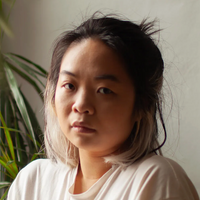
Ash Goh Hua is a Singapore born and raised, New York-based filmmaker. Utilizing both documentary and narrative forms, Ash laces personal stories with quotidian magic to reveal the politics embedded within society, relation, and culture. Named one of the 25 New Faces of Film by Filmmaker Magazine in 2022, Ash is a 2024 Berlinale Talent and a 2025 Creative Capital Award recipient. Ash began her career in non-fiction with I’M FREE NOW, YOU ARE FREE (2020, distributed by PBS POV Shorts) and the Oscar®-qualifying THE FEELING OF BEING CLOSE TO YOU (2022, distributed by The New Yorker, Best Documentary Short Award at the New Orleans Film Festival). Ash ventured into the fiction space with her first narrative short FULL MONTH (2025 Sundance Film Festival, supported by Berlinale Talents’ Short Form Station, distributed by NOWNESS). Ash is currently in post-production for the fiction short SUBTERRANEA; working on the short doc UNTITLED DURIAN FILM; and developing her first feature.
Conversation
On putting yourself in uncomfortable places
Filmmaker Ash Goh Hua discusses treasuring your collaborators, practicing every day, and how to know you're surpassing yourself.
As told to Reina Bonta, 1788 words.
Tags: Film, Collaboration, Process, Focus, Family, Inspiration.
You were born in Singapore, you now live in New York, and you’re currently speaking to us from Colombia. How has a global perspective contributed to your work?
[A global perspective] is integral to my work. The way I live my life allows me to form a perspective that I bring into my work. I’m very cognizant of the different ways in which the industry moves. And I almost feel like the way in which my life has spanned out across territories has allowed me to glimpse a possibility of bridging these different industries. Because the American industry is very insular and the international film industry is very international. A lot of times my friends in Asia are like, “The American market is so off.” It seems like you can’t tap into [the American film market] if you’re outside of it. And similarly, when you’re inside the US, it feels very much like a bit of a circle jerk. Being able to see the expansiveness of different storytelling legacies and the ways in which people see the world is something that is very important to me and that I continue to massage in my practice. I want to be somebody who can be porous.
Does that contribute to the way you think about audience when you’re making work?
I don’t know if I ever really think about audience. It’s always really hard when you’re writing a grant application and they’re always like, “Who’s your audience?” I think for me, [the answer to that question] has never really been a kind of person. It’s more about a feeling. If I’m making a film about homecoming, it’s about feelings of alienation. And so, my answer would be: this is for people that feel alienation. I think there are so many ways of arriving at that particular feeling, whether you are from the Global North or the Global South. So I don’t really think about audience specifically when making my work.
How has the collaborative process of making films in community impacted your creative journey?
I could never make a film in a silo by myself. That feels insane to me. I could never do that. When I first moved to the U.S., I didn’t really know anybody. Film became my entry into meeting people, and doing fellowships is where I got to meet other filmmakers. That really helped me become a filmmaker in New York City. That’s one of the most wonderful things about filmmaking to me: it’s a very collaborative medium. I mean, you could break your back and do everything yourself, but why would you want to do that? I have people now that I trust and always work with, and it’s always so exciting to be able to do that together. And I think filmmaking feels like a team sport. I think that for me is what I love about filmmaking.
Do you return often to the same collaborators, or do you try to work with new creatives when building your team for a film?
I have a core group of people that I super trust. Then, there’s always people who are interesting and I’m like, “Oh, what would the project feel like if this person touched it?” Sometimes, it can be a bit of a funding thing. If you got funding from the Spanish government, you have to hire a Spanish cinematographer, for example. Sometimes you’re restricted to those kind of things. But I definitely have people I can count on one hand whose sensibilities match mine. Those are the people I ask for feedback from. I think it’s so important to have those people when you’re a creative person, when you’re a filmmaker, because while there are so many wildly talented people in this world, it doesn’t mean that you align in terms of sensibility, nor does it mean that they have their heart in your project. You know what I mean?
When you find people who do have their heart in your project, never let them go. This is true in not only filmmaking, but in life. There are so many great people in the world, but if you meet somebody whose heart is with you, it’s invaluable, right? You should treasure that and protect it with your life. Also, you can build a skill with somebody. And so, even if somebody doesn’t have a skill yet, it’s something you can grow together. We can grow together as people and as professionals. But once you find the right people, keep working with them.
You are currently making two different films–a narrative short film and a documentary short film. How are you holding these disparate forms at the same time?
It’s a creative exercise. I think I need that kind of stimulation actually. I think it’s very helpful to be dabbling in different mediums. My work has become very hybrid. I’m weaving these disparate threads, these different mediums, and intertwining nonfiction and fiction. And I’m always trying to challenge myself. What interests me is to challenge the form that I’m working within. I think about how filmmaking is so expensive. Why are we making a film when it could be a photo series or a podcast? I think for me, I’m always thinking, “Why does this story warrant a film?” I try to really make it warrant the film form. Sometimes, that means pushing the form and making different creative decisions.
Much of your work is deeply intimate and uses archival home video of yourself as a child. Are there any aspects of your lived experience or identity that took time before you felt comfortable with before bringing them to your work?
I think it’s always very uncomfortable. But I think I’ve learned that if it feels uncomfortable, it’s a good thing and you should lean into it. I’m always trying to put myself in an uncomfortable place because that means that it’s generative; I’m growing and I’m surpassing myself. I don’t think this is the only way to make films, but I don’t know how to make films not from a personal place. I think there are a lot of people who do it and they do a wonderful job, but I think, personally, I don’t really know how to not [make personal films]. I lead with my heart first with whatever story I’m trying to tell.
How do you process personal experiences through your work?
For me, it’s one world. Everything is intertwined. The life experiences I have always lead back into my work because my work is the way in which I process my life. I made a documentary with my mom and it was me being like, “I really want to talk about my mom. Maybe it could be a film because that’s how I know how to process my feelings.” Filmmaking is a tool in my brain to work through my own conundrums. If I’m interested in one thing, I’m going to go make a film in its world because it brings me even closer to that thing.
How do you navigate doubt during your filmmaking process?
I’ve definitely felt like I don’t know what the fuck I’m doing with every single project I’ve ever done. But that’s a very real, natural part of the process. So, surround yourself with people you trust with your life–not just collaborators, but also friends who love you and keep it real with you. And secondly, just be honest with your work. If you feel that something you’re putting out is the best that you can do, then that’s all we can do. People can criticize, but at the end of the day, if you are good with what you’ve done, you’re good with what you’ve done. I think back on the films that I’ve made in the last five years. Would I make the same creative decisions now? The answer is probably not. But I made those decisions then and I was being very honest in that moment. And if I want to do things differently, I’ll just do another thing now.
Do you have any practices, creative or otherwise, that elevate your own creative process?
I watch a film a day–that’s a part of my practice. A lot of times, it’s short films because you don’t always have time to sit and watch a feature-length film, but I watch a lot of films and I just do it because I love it. As a practitioner of film, it’s important to watch films, know films, and know the other people who are making films. It’s like when you learn a language; you have to practice every day because that’s the nature of a language. To me, filmmaking is a practice about humanities, and I think the more you’re exposed to it, the more you’re immersed in it. I think knowing more of what you like and what you don’t like informs what you decide to make, too. Yeah. My Letterboxd is crazy, y’all. I love Letterboxd.
I also work out every day. I stretch every day. I read every day. I love walking my dog in the morning; I’m journaling in my mind—don’t touch me, don’t talk to me. I love that. Filmmaking is so tied to experiencing life, the worst parts of it and the best parts of it. I just love living my life and filmmaking is a way in which I’m putting a magnifying glass up to the world. And so, the more present I am, the more committed I am to living my life, and, say, feeling anxiety when I do feel anxiety or feeling grief when I’m feeling grief. It’s so wonderful to be heartbroken, even. You know what I mean? Because it means that I am alive. How can I not feel grateful for that, even if I feel horrible? And you’re relating to the world when you’re making films. It’s what life is about—this range of colors and emotions. When you’re in the dumps, there’s somebody else that’s going through it and knows what it’s like, and that’s a way you get to connect to somebody. Filmmaking is the bridge to that for me. It’s the vessel in which I use to process, experience, and imagine the world.
Ash Goh Hua recommends:
Learning a new language
SPF on your face and tattoos everyday!
Rewatching/rereading Naruto (skip the fillers)
Joachim Trier’s entire filmography
Turning your phone off so nobody can reach you then buying a sushi platter and eating it all by yourself while you play Pokémon
- Name
- Ash Goh Hua
- Vocation
- filmmaker
Some Things
Pagination