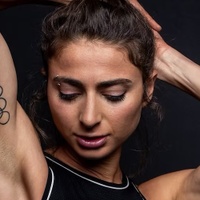
On sustaining a career by staying curious (and fighting for creative control)
Prelude
With over half a billion streams globally, Allie X has cemented herself in the pop pantheon as one of music’s sharpest, most insightful, and trendsetting artists. She has headlined sold-out shows across North America, Latin America, and Europe and toured the world with Dua Lipa, Troye Sivan, Charli XCX, MARINA. Known for her bold sonic and visual style, Allie X has a hand in every aspect of her project from producing and writing her own music, directing her own videos, to hand picking her own fashion and glam teams and creative directing her album artwork. This singularity has attracted much attention from the fashion world (Iris Van Herpen, Alexander McQueen, Olivier Theyskens) as well as the LGBTQ+ community where she is a celebrated and outspoken ally, spearheading charity events and guest hosting Drag Race. Hughes’ self-produced fourth record, Happiness Is Going to Get You, is a patina-tinged whirlwind of infernal and liminal pop nostalgia. Elaborating Hughes’ signature dark whimsy, Happiness Is Going To Get You is a ferrotype portrait of a woman in free-fall that balances an inevitable truth: happiness is coming.
Conversation
On sustaining a career by staying curious (and fighting for creative control)
Musician Allie X discusses the pros and cons of creative control in a music industry career, why curiosity is underrated, and why you shouldn’t give up on that messy initial idea
As told to Max Freedman, 2364 words.
Tags: Music, Business, Collaboration, Independence, Production.
Happiness Is Going To Get You is your return to piano-based songwriting for the first time in about a decade, so can you tell me about your production process? How did you get these songs into their final forms?
My plan was to make piano demos, find a producer, and pass it off to someone else early on, because I had produced the last record and I was really exhausted. The process of doing all the creative left me feeling like I didn’t want to do that again. It was good that I did it, but I wanted this to be more collaborative and fun.
But then, what ended up happening was, as I made the piano demos, I started getting ideas for other arrangements and parts. I was having fun, so I produced it out and ended up taking it much further than I had intended. I did end up bringing on a co-producer, which was also super fun. His name is Bastian Langebaek, and we finished the record together in Copenhagen.
You said that, with Girl With No Face, the production eventually exhausted you. It sounds like that didn’t happen with Happiness. Do you have any sense as to why there was that difference?
No, I don’t have a real tangible understanding of why. It just felt like Girl With No Face almost created some sort of—the struggle of it almost created some space for [Happiness] to exist in some sort of mystical way, and then it just dropped into my lap.
It almost sounds like it just magically came together in the way that many songwriters I’ve spoken to have said—it’s less about consciously writing and more about catching something that’s in the air.
Yeah, exactly. This was one of those, with little moments of little puzzles to solve. Of course, now that I’m promoting it and in the trenches of chasing numbers and analytics, it doesn’t feel very fun. But the creative was quite seamless and one of those experiences that reminds me how lucky I am to be a creative and a songwriter, and how magical it can feel.
For this album campaign, you’re going with a very distinct visual aesthetic, which is in character for you, but I’d love to hear if that’s a part of making the marketing side of things easier, an honest reflection of who you are in your creativity, or some balance of both.
It’s mostly in conjunction with the creative of the record and world-building, which is something I do regardless of if it works as a marketing strategy. If I tried to do a record where I didn’t build a world and create some sort of character, I wouldn’t know what to do.
I’m definitely not a marketing person. If I was, maybe I would be bigger by now, but as an audience member, a listener, I enjoy artists that do that sort of thing.
It’s interesting to hear you say “I would be bigger.” I don’t think you need to be bigger—you seem to have a pretty devoted fan base. Can you talk about how you’ve managed to make a financially stable career out of being creative and having a fan base that isn’t the biggest in the world but just really loves you?
The way I’ve done that is by fighting tooth and nail against the music industry and all of its standards and contracts and, behind the scenes, being a complete rebel and fighter in a way that probably none of my fans understand.
It’s an industry where the artist is set up to be not the winner, but the currency in a big lottery game. You’re the currency, you’re the ticket, and if you say yes to everyone on your team and follow the traditional path, the likelihood of you having a sustainable career is very low, is what I found out. There’s so many times where you want to please people, be likable, and make people excited about you, but what you’re actually saying yes to is not in your best interest. I’ve had to learn that the hard way.
What I’m speaking toward is taking advances in exchange for your rights and your backend. I’m talking about having these massive spends on campaigns that aren’t anywhere near at scale with what you’re generating income-wise. I’m talking about extended teams of 30 to 40 members, all of whom take a piece. I’m talking about not having oversight into your contracts or legal.
All of these are super standard practices, and there are cases to be made for all of them depending on your situation. Sometimes, you really just need to bet and gamble, and that’s okay. But if we’re talking about building a sustainable career around a following the size of mine, which is moderate, I’ve had to learn how to operate in a very realistic, boring way.
It’s not very glamorous, and you lose that sort of industry infantilization of being told, “You’re just an artist. Don’t worry about it. We’re going to put you in a business-class seat and fly you to the nice hotel.” I’ve had to let go of that and have much more of a—I guess you could call it DIY, and very grounded in realism, which isn’t always that fun—kind of career. But in exchange for that, I have a sustainable business, complete creative control, and, as of this album, all ownership of my royalties, except for the 15 percent that is unavoidable that goes to administration.
The industry has a hundred other lottery tickets, and one of them is going to win. The odds are in their favor, not yours.
Girl With No Face and Happiness Is Going To Get You are coming out only a year and a half apart, which is shorter than you’ve usually taken between albums and also feels shorter than the industry expects of artists these days. I’d love to know how you balanced what the industry might expect with the timeline on which you genuinely want to roll this music out and share it with the world.
I’m dealing with that right now, and it’s really annoying, because on the last record, I was getting the feedback, “It’s been too long, and so-and-so doesn’t work wherever anymore,” or, “Your monthly listeners have gone down, so you can’t do this press piece.” I did [Happiness] quite quickly, not to appease any industry standards, but just because it came quickly, and now, I’m getting the same feedback, but in the opposite way, which is, “It hasn’t been long enough since so-and-so covered you.”
I like to put the most odds in my favor, and I’ll hire PR, digital marketing, and all the people that do the things, but ultimately, the music needs to lead the way. I really believe that good music finds an audience. If industry, press, or whatever people want to get behind it, that’s cool. And if they don’t, then whatever.
Going back to something we were talking about earlier, you’ve cultivated very distinct looks in your music videos, and you have some close friends within the drag community. To what extent do you see fashion as an expression of creativity?
More and more. The longer I do this, the more I understand why they’re so intertwined. Fashion can be a suit of armor. Drag queens have taught me a lot in that sense. I’ve also become friends with a designer recently based out of London, a Scottish designer named Charles Jeffrey. I’m in such awe of his work, his flow of creativity, and how good it feels like having a collaboration like that. It feels so inspiring and protective, the way one clads themself.
In music, in fashion, when do you choose to collaborate versus go solo? Is it an intentional choice to collaborate or do you just feel the energy of, “I need a collaborator. Let me work on that”?
It’s two things. If we’re talking musically, I spare no expense—whatever I need to do to make an incredible record. If I’m feeling like I need a collaborator, then I’ll get one, and if I’m not, then I won’t. In that sense, it’s very much intuition and instinct, and I’m not hindered by budgetary concerns.
Across pretty much all other areas of collaboration—fashion, makeup, hair, set design, tour production—it really does become a budgetary question of, “Do I have money to turn a look this hard tonight?” Or do I want to make money on this tour, or do I want to do the whole thing and be really tired and miserable knowing that I’m not going to have any sort of a profit?
Girl With No Face was mostly something you created on the computer, and with Happiness Is Going To Get You, you had moments where you heard songs in your head that wouldn’t work for the computer, so you went to the piano. Were there any challenges or doubts you had while sitting at the piano that you had to work through because it was a different process for you?
No, not really, because I wasn’t putting pressure on it. I was simply capturing. I was just capturing really vague ideas that lived as voice memos, and…it was just sort of like, “These are ideas for the future. They may die in this iPhone memo app, or they may see the light of day.”
When I started developing them, Girl With No Face had just—that tour had just ended. It was just for a lark. There was no pressure at that point. However, when I was making Girl With No Face, that felt like pressure, more because of the circumstance than the nature of the production. It was more about, “I’ve given myself some years to do this, and it’s still not together, and I need to deliver something, and I promised myself that I would do it myself, and I need to learn how to use this gear.”
How did you learn to use that gear?
YouTube and curiosity. Curiosity is underrated. And with these overstimulated, dopamine-addicted brains that we have nowadays, it’s harder to get curious about things. A deep curiosity is usually what makes the perfection of any sort of craft. Not to say I perfected anything in any way, but my curiosity allowed me to dig deep, read a lot of books about that era of music, and watch a lot of documentaries.
I’d love to hear more about how your curiosity manifests in general, and how you address or pursue it.
I’m really interested in continually evolving and not settling into any sort of one identity or way of being, or even one city. I don’t know if I call that curiosity, but it definitely works hand-in-hand. I’m also always searching for inspiration, and that works hand-in-hand with curiosity. If I find something that inspires me, it doesn’t take much to get me excited and be riffing on it and saving it.
I’m kind of going off-topic, but one thing that comes to mind for someone creative that might be reading this is, it’s amazing how unformed, embryonic, and messy an idea can be initially. When I was younger, I didn’t understand how malformed something could be to then turn into something completely formed and awesome. I wish someone had told me that. It doesn’t look pro even when you’re a quote-unquote “pro.”
That initial sketch can be a piece of shit. You start to understand that all you need is something that looks like a piece of shit that excites you, and it can turn into a whole physical record, a line of merch, a tour, an identity, a hundred pieces of content, an advertisement, and all these things.
To ask you about something that’s a little older, I’d love to know what you took away for your own creative processes when you worked with Mitski on “Susie Save Your Love.”
She’s such a good songwriter. She just lets it flow. One thing that struck me is, she was not interested in co-writing for herself. She came into the pop co-writing world of Los Angeles for a couple weeks, and I was one of the artists she worked with during that time just to dabble in it.
I remember in our session, the guys that we were working with were like, “We should write for you, Mitski.” And Mitski was like, “No, I don’t do that.” … I learned after that that I’m one of those artists that’s better to be by myself in a room coming up with an idea.
That’s one thing I remember about Mitski. I also remember that “Susie” happened so easily and seamlessly, and we weren’t trying to follow any references or trends. We just let it flow, and it almost became this yacht rock-type thing but totally worked.
When we wrote that, it really didn’t fit on—I was working on Super Sunset at the time, and so I put it aside. When Cape God was forming, I was like, “I think ‘Susie’ would work on that record.”
Is there anything more you want to say about creativity in general, or about any of the questions I asked that you didn’t get to say when I first asked them?
The problem with people becoming creatives, the hurdle that stands in their way, is judgment and insecurity a lot of the time. I would just reinforce that an idea is never fully formed when it first comes to mind. It’s like a little seed, and you just need to nurture it. Sometimes, it takes years, and sometimes, it takes a really short amount of time, but nothing needs to be fully formed or quote-unquote “professional” in its first iteration.
Allie X recommends five works of modern fiction:
Convenience Store Woman by Sakaya Murata
Tomorrow and Tomorrow and Tomorrow by Gabrielle Zevin
Severance by Ling Ma
Swing Time by Zadie Smith
Death In Her Hands by Ottessa Moshfegh
- Name
- Allie X
- Vocation
- Musician
Some Things
Pagination