On opening a new door
Prelude
Conversation
On opening a new door
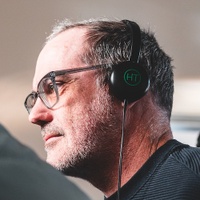
Musician and GUNK co-founder H. Pruz discusses collaborating with family members, why limits make them more creative, and playing games as an adult.
As told to Maryam Said, 1361 words.
Tags: Music, Collaboration, Family, Inspiration, Process.
I saw that you worked with your cousin for your “Krista” music video. What was that process like?
Yeah. We made hundreds of videos and I basically privated all of them since, but they’re still unlisted on an old channel. My cousin Molly and I made so many videos together and that music video was made from a series that we had written and recorded, edited, and directed ourselves. It was a horror film. It was really cool to piece that together and play around with memory. Molly also directed the final music video for “After Always,” so it was cool to bring her in.
Is there a different process when you’re working with family than when you’re working with friends?
Definitely. I have no sisters, but I have two brothers, and so I do really view Molly as a sister. I feel like it’s easier for us to be honest about issues that come up with creating things together, and we both have really strong creative voices. It was a lesson for me in releasing control, which I think a lot of the record making was, too—with Felix, who is my partner and, in a way, that’s like my new family. I think it’s really easy for me with both types of family, all types of family, to just be really open about what’s working and what’s not working. I had a lot of difficulty with releasing control, but being able to do it with family, it was good to have that pushback—which I think I have with a lot of my friends, but it can be more of a fragile zone. There’s this catchall, like, “We are going to be okay at the end of this.” From all sides surrounding it, though, we all were like, “We might not agree creatively on what this is going to look like, but it’s going to be okay. We’re putting our relationships aside and it’s going to be okay.”
Do you have any rituals you do before you begin your recording process?
Running is really key for me, in writing a song and recording a song. I compulsively need to run a lot because mentally it just stabilizes me and my creative flow. Every other day I’m running and, if I’m recording, I’m usually listening to a mix we made, or a demo or something.
I got into running last year for the first time and it’s freeing.
I agree. I agree.
Has your recording process changed since you started making music between your EP and today? Are there things that you’ve kept in your toolbox from the first record that have been helpful while making this one?
When I made the first EP, I was recording everything myself on a podcasting mic. I didn’t really know what a good mic was. So everything was through a Yeti podcasting mic. I had the gain all the way up. You could hear so much of the room. Something that has stayed with me from that point, though, was I just had this intuition of people I trusted to work with. At the time, it was Colin Miller; I had just been a fan of his music and his writing and I hit him up and we made those recordings together, just sending them back and forth during the pandemic. That was really, really special: to watch what someone would decide to do based on where I started a thing, and then to go back and forth.
Since then, I’ve recorded basically everything with my partner, Felix. So another person that I feel really comfortable with figuring things out at the ground level. We recently transitioned, with the last record, into recording on tape—which is something I really love doing, in that it creates a lot of these limitations with just how many tracks you have and what you want to record on them, what sound you like. You’re deciding on a lot of specifications from the jump. I think that it was good for me to have limits. I think limits make me more creative. Felix really instilled in me this idea of taking full takes of anything we did. There was very little cutting and pasting.
I want to talk about your editorial project GUNK. How did that happen? How did you get started making a zine called GUNK?
I have heard so much through Felix, who grew up in New York City and in the underground DIY scene at Silent Barn, about that community. I largely missed a lot of that. I started off in a medical career and had a fully different life. But one thing that I would hear about a lot was something called SHOWPAPER, which was this longtime establishment of a biweekly paper media newspaper that listed all of the all ages shows in the tristate area, and they closed down because they ran out of money.
That is such necessary work… The last question I have about the record is why and how you made a role playing game for the record?
I think I am just fascinated by imaginary worlds and how they allow us to problem solve and tell stories. The video that I made with my cousin as a child, I think we were trying to tell a story about family trauma and relationships in the context of the haunting of this scary little child. With the game as well, I was trying to tell a story—but I like that with games and with RPGs, there’s a lot of interaction from the player. With music, I feel like once I make something with the band and with my collaborators, there’s not much that a listener can do to interface with that other than to listen to it and connect it to things. But with an RPG, you can really just take it in any direction you want. I hope that it pulls out for people things that games have pulled out for me growing up and what making music has pulled out for me.
Right now, that’s where I’m drawn creatively. It was really cool to make a little game with someone—the visual artist, who’s my friend, and we play games together. I think playing games as an adult can be looked down upon. But I think it’s just an incredible means of storytelling that allows for interaction, which is rare.
It weaves itself into the music as well.
Yeah. Definitely. The visual artist, Jono, made the album artwork based off of some inspiration points I gave him. It follows a journey of a wayward traveler setting out at sea because of the maritime saying from the title, Red sky at morning. It’s not a concept album by any means, but I think I wanted to take some of the themes from the album and create a completely different story. So it is not what I’m trying to get across with the music necessarily, but it was cool to just take something I’d already made and reform it and change it in a different medium… I want it to be introspective and I think a big part of the inspiration behind the game was, of course, tabletop role-playing games, but also The Artist’s Way.
The book?
Yeah. I was going through that book earlier on in my life, and that was one of the big reasons why I started to make music by myself. I was just hoping to make something that might open a door for someone, or ask a question that could open a door.
H. Pruz recommends:
making this halloumi, cuke & walnut spoon salad in the summer
listening back to voice memos on a long run
riding the nyc ferry on a particularly hot day
picking up local zines left around your neighborhood. My current local favorites: stitches, the goose egg, life harvester
keeping rose water spray in the car. instantly revives me on a long drive.
- Name
- H. Pruz
- Vocation
- musician, GUNK co-founder
Some Things
Pagination