On turning dark times into beautiful things
Prelude
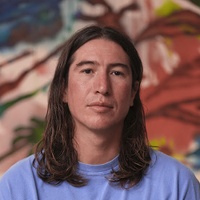
Ed O’Brien is an English guitarist, singer, and songwriter. He has recorded legendary albums as a founding member of Radiohead, and released his first solo album, Earth, under his initials EOB in 2020 to critical acclaim. His new album, Blue Morpho, was written in the process of getting through depression that grew during the COVID lockdowns.
Conversation
On turning dark times into beautiful things
Musician and Radiohead guitarist Ed O'Brien discusses the ins and outs of his spiritual practice, why it's natural to suffer, and subconsciously creating utopias of sound.
As told to Lior Phillips, 2839 words.
Tags: Music, Inspiration, Mental health, Adversity, Collaboration, Privilege, Success.
My computer’s slow… I’m going to quickly close millions of tabs in my browser.
Good. Simplify your life from tech, Lior.
I’m trying! I’ve moved away from streaming wherever possible, focusing solely on vinyl and CDs, even getting DVDs from the library. I found these Verve and Chemical Brothers CDs at a garage sale the other day [shows them over Zoom].
Look at you! In ‘97, I remember OK Computer and Verve sort of being in a similar place. I remember we were on a tour bus during the OK Computer tour in the UK, and Colin [Greenwood] and I played “Bitter Sweet Symphony” and “The Drugs Don’t Work.” We were like, “Oh, my god, this is the best.” Even The Chemical Brothers—they were both at Manchester University, like myself. I think we overlapped by a year, but I didn’t know them.
I love this memory you’re recalling. Speaking of physical media, I don’t know what your plans are for touring this album [Blue Morpho], but I want to be in a room with people listening to it.
That’s what I want to do. It starts off in the labyrinth. “Incantations,” for me, was this dark place. It felt like I was in the labyrinth for this, and it’s dark, and you can’t feel your way out. You’ve got this thread and you’re feeling your way through it. When you sequence the record, you’re not thinking of it so literally, but you think of it as a musical journey. But I think of “Obrigado” as giving thanks at the end. It is a release. I have enormous gratitude for that time that I went through—that darkness and learning to be at peace with the fears that I had, the trauma and all of that, seeing it and allowing that. I think it’s nice to have a happy ending, right?
If you’re out of the labyrinth, what grace do you give yourself for those feelings now?
It’s great that you use that word grace because one of my daily mantras since that period is, “I’ve got courage, I’ve got strength, I’ve got grace.” I say that every day when I come out of meditation. And grace is such a beautiful word in itself, isn’t it? It’s an acceptance of things as they are, and the ability to feel that no matter what, you can overcome this. Buddhism always talks about the nature of suffering and how, as human beings, we will suffer. For years, because I’ve got this incredible good fortune, I’ve won the golden ticket, I thought I shouldn’t be allowed to be suffering. But then you realize that’s complete nonsense. Everyone can suffer. Everyone does suffer.
I think we’ve got ourselves into a state whereby, as a society, we have this complete aversion to pain or suffering. We kind of run from it. Obviously there are thresholds. If it gets too mighty, then you always need help. But you can get through this, and that’s where we grow. That’s where we become whole. That’s the story of the sages, right? All the stories from the ancient Greeks and the ancient Egyptian onwards, they’re all about suffering and they’re all about the stages of life. But the other thing that’s interesting is that when we talk about “mental health,” it’s such an inadequate way of describing what people go through. It’s like, “Oh you’ve got mental health issues? Would you like some carrots and peas in that as well?” This is fucking torture. When you really understand mental health or depression, this is something that people have suffered for ages. It’s a spiritual moment. It’s an emotional moment. It’s a physical moment. It’s not just of the mind. It’s all aspects. It’s the environment that you live in life. The cynical side would say that society wants you to get through this quicker so you carry on being a good, happy consumer. But we must breathe. We must feel the fucking earth. We must feel all that. We must feel it.
Just because someone’s perceived to be in a “better” state doesn’t mean they shouldn’t be granted grace.
I don’t talk about this normally. It’s obviously part of the record and I’m kind of riffing on it… I’ve had a history of being quite open about depression throughout my life. People come up and say, “I’ve struggled.” And I always say this: “I think it’s possibly the most legitimate response.” If you’re a sentient and sensitive soul, with everything that’s going on in the world, and if you live in a city, it’s the most legitimate response to what’s going on. The only reason I’m not like that is because I’ve now got a framework which helps me to stay balanced and whole.
Tell me more about the framework in regards to the creative process.
Yeah, I’ll let you in. I’m a real mongrel. Everybody’s unique. You have to figure out what works for you and what doesn’t work for you. So for instance, when I was in this dark place, I had this spiritual practice which starts with meditation in the morning. I’m a mongrel meditator. I taught myself to meditate. It’s been so amazing because that’s the most useful tool to still the mind. Something that I always tell my friends, if they’re going through it, is, “Do you meditate?” I’m really a boring friend. And they go, “No.” I say, “Okay, learn to meditate.” They should be teaching it at school.
I think people are very scared of it. We’re taught to just suck it up and move on. I think meditation calls on you to be very much yourself. And a lot of people don’t like that.
No. It’s uncomfortable, but it’s so powerful. I wake up in the morning: 6:30 AM, get up and meditate. Then I’ll sit outside, and I hear the birdsong, rain or shine. I put the hood up if it’s raining. A cup of tea. Just to hear nature. Then I do some weights or tai chi, something to get the body moving. I’d have a shower, and then bang, I’m ready. And then I go into the studio. When you’re younger, you sort of have an aversion to routines. But the older that I get, I realize the better they serve you. My body learns at a certain time that I’m going to meditate at 6:30 AM. It learns to be there. It learns that at 11 AM I’m in the studio. That’s when I start working, and I work through until 6 or 7 PM.
Are you working in the same, familiar studio setting where you work with Radiohead?
Yeah. I mean, it’s been a long time since doing the Radiohead recordings. It’s been over 10 years. It’s like another lifetime away. The only time I’m in the studio now is with my own stuff. And then I went into Paul [Epworth]’s studio in London, too.
How do bring your routine into travel like that? Does it go smoothly?
I’m pretty good. Where we were in Hampstead, you get a good dose of nature. There are even owls at night. I need nature. I’m a country boy, and you can get these fabulous pockets in cities. What was great was I would walk to Paul’s studio across the Heath every morning. You feel the seasons. It’s a four-mile walk and it’s up and down. So the ritual, the routine, is pretty standard.
Are there any specific totems or resources that you need around you to keep that consistency?
It sounds a bit cliche, but I think my whole thing, my way of life, is to be the best version of myself—whether it’s as a human being, in my relationships, and as a creator and an artist. We’re conduits. It comes through us. And the more balanced and the more whole we are, the easier it comes through. So the room is super important. The room here in Wales, it’s a room in the house and we’re recording in the sun. We’ve got the windows; they’re these sash windows, floor to ceiling, and we just lift them up and the sun’s coming in. And then Paul’s room, The Church Studios, is just extraordinary.
One of the things that’s so interesting about creativity is you create an environment. The room that you work in is so important. So when people like Shabaka [Hutchings] can come in, you’re holding a space that people naturally feel, “Oh, I’m safe here. This is an environment.” They can feel the love, the warmth, the support.
Speaking of Shabaka, did you have a conversation with your collaborators about what you had gone through, or your emotional state and experiences that inspired the album?
No. None of that. In 2023, I think, Shabaka had said, “At the end of this year, I’m not going to play sax anymore. I’m going to really concentrate on the flute.” So he did this flute set at the Crow’s Nest in Glastonbury on the Saturday afternoon. It was a beautiful afternoon, just hypnotic. And I actually went and spoke to him afterwards.
This album’s recorded at a specific frequency, 432 Hz. So the first question I had was, “Are any of your flutes in 432 Hz?” And anyway, we started to riff on it about four months later. He was in town and spent an afternoon with us and it was beautiful. The thing is, you don’t need to be literal. I think good musicians can get a feel. They go, “Okay, I can feel the depths of this. I can feel there’s some darkness here, but I can feel the light. There’s a beauty here.” There’s an intuitive thing that goes on, and it works much more on a subconscious level. And we’re British guys. We don’t like to talk about it too much unless we talk about it with good friends. Women are much better at talking about this stuff than men.
The only measure you have is your own experience and yourself. Putting out work like you have—work that has profoundly changed the way that people listen to music, the way that people feel—that is your role in the world. I’m sure you know that. There’s no heaviness to it. It’s just celebratory, in my mind.
I’m glad it feels that way, because it is celebratory. The role of an artist is to be true to what comes through, what you really feel. And I think what we’ve always done in Radiohead… I mean, it’s interesting, because going through this dark night of the soul, I had a bit of a revelation. What we did collectively was we were spinning. We were taking darkness and spinning it into something beautiful. It’s like alchemy. Particularly I think about a record like OK Computer, how we put it together and all the rehearsing and the process of that. We never say this, but I feel like subconsciously we’re trying to create these sort of sonic utopias. A song like “Let Down” inhabits a space where you feel safe, or there’s a beauty in that place because maybe we hadn’t always felt safe in where we’d been. It’s such a blessing to be able to do that, to be able to take something dark and to be able to literally alchemically shift it into something of beauty.
I can imagine that at the same time you can’t take it too seriously. I don’t think you were going out into the world like, “Right, we are going to change music forever.”
Never. Exactly. I love the ordinariness of it. You only experience what you experience. So there’s a normality that I feel about my life. It’s extraordinary. Did you see The Beatles: Get Back documentary? I resonated with that so strongly. It felt like one of our band rehearsals. You sit there with a cup of tea and it’s just people being ordinary. Some moments are completely shit and other moments are completely magic. My son is 22 now, and he said this to me in January, after the recent Radiohead tour: “Dad, I don’t think you realize how big Radiohead are.” I thought about it, and I said, “I think you’re right there. I’ve got no idea.”
Honestly, if you knew, I think you would combust. Because I think lives did change.
My spiritual practice and my spiritual beliefs really, really helped me in this because I feel very strongly that I’ve had many, many lives and we reincarnate. It’s our job to evolve as souls. I’ve just been blessed in this life.
I never think about an audience when we’re making it. I’ve realized this: you make music you want to hear. It’s often an amalgam of different things that you love, but you make it for yourself and you get to a point where you go, “I’ve got to release this.” You just do stuff, and how you do it is completely guided by your intuition. Maybe six, seven months after you’ve finished that thing, suddenly a deeper level is revealed about that piece of music. And that was never consciously going on. Let the intuition—your heart—be your guide. Your intuition can see your whole life’s journey mapped up. Your mind, however, can only see what’s in front of you. So if you follow that, and you back it up with a bit of the mind—you dot the i’s, cross the t’s, make sure you’re not being a complete nutter—that’s when life becomes extraordinary. That’s when layers of depth reveal themselves.
When you talk about intuition, do you write from a place of messiness? Do you let that expansive idea fill out?
[For this album] I didn’t think about it. Any time I got something that felt okay, I’d just record it on the phone, on Voice Memos. I was basically for a year in this dark place, and I just had a year’s worth of musical motifs, probably about 50 or 60. Some of them were more developed than others, and I really didn’t think or judge them at the time. When you get your balance and you feel whole, it’s time to review it. I had thought that there was nothing much there. Then I listened to it and I was just like, “Oh, my god.” I just think it’s extraordinary that, in these kind of mathematical intervals that are called notes, you can capture an emotion or a feeling. I mean, that’s miraculous.
For me, the way that I write, I see it and I feel it. It’s like a co-creation with the spirit. I’m letting go. It’s coming through me. It was the first time I’ve worked on something when I really was aware of that and I let go and I didn’t worry. And if something wasn’t working, I didn’t necessarily feel like I had to find the solution. My job was just to identify and say, “This isn’t working. I don’t know why it’s not working.”
But you have to find a clarity within yourself to be that conduit. That doesn’t seem like an easy task.
I think one of the things is humility. I’m always trying to figure out how I can be the best conduit. How can I be the purest vessel for this to come through? My spiritual practice plays a deep part in that, but genuine humility and gratitude—I am so grateful for everything. Part of my practice every day is just writing down in the morning what I’m grateful for, especially when you feel you might be in the depths. You just hear birds in the trees and you give thanks for the sun rising that morning, because gratitude is such a powerful thing.
I understand Thom Yorke gave you some songwriting advice a few years ago.
Well, he went to art school, and what was so interesting about art school was they give you a framework on which to hang creativity. So a lot of it is really good habits. It was at Jonny [Greenwood]’s 50th. We were stood by the fire, chatting, and I’d never really talked to Thom about songwriting. For me, he’s this titan of songwriting. He’s a master. And he said, “It’s the craft of it. You’ve got to be a librarian. If you’ve written something, you’ve got to keep an eye on what you’ve written.” And I love that. I love that it’s based on a craft, rather than talk about inspiration and all of that. It’s just really practical advice.
- Name
- Ed O'Brien
- Vocation
- musician
Some Things
Pagination