On taking a leap of faith
Prelude
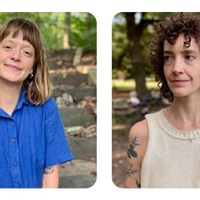
Miss Grit (aka NYC-based, Korean-American Margaret Sohn) has been recognized by i-D as a “singular talent” for their “compelling ideas and freewheeling creativity” and by Rolling Stone for their “elliptical, hooky songs that take unexpected turns.” Surrounding the release of their debut album, Follow The Cyborg, Miss Grit was profiled by Rolling Stone as an “Artist You Need To Know,” they performed for The Late Show with Stephen Colbert’s online series, and the album was included in Pitchfork’s “Great Records You May Have Missed.” With their sophomore album, Under My Umbrella (out this Spring on Mute), they’ve lifted the lid on their internal world, honing in on the anxieties and heartbreak of the past two years. Magnifying Sohn’s gift for complex production, the album channels the noir-ish atmosphere of classic trip-hop bands, while adding a hefty dose of maximalism and a dream-pop sensibility.
Conversation
On taking a leap of faith
Musician Margaret Sohn (Miss Grit) discusses calling on others to help you get past a creative block, balancing artistry with the need for a day job, and finding kindness for your previous work.
As told to Max Freedman, 2504 words.
Tags: Music, Collaboration, Creative anxiety, Money, Process, Day jobs.
When your day job has gotten in the way of your creative work, how have you handled it?
My mental space needs to be pretty clear and unbothered by other stuff to be able to sit down, write, and access the hard feelings, so it can get really tricky. I’ve kind of struggled with that, honestly, because this is a new job that I’ve taken on since last fall, so I still have been adjusting to that. But I’ve been doing a lot of visual creative work, and I found that that’s okay to do in tandem with the job. But when it comes to songwriting, I haven’t been able to do that yet on the same day. It definitely takes a toll after a while.
You said this is a new job. Was there a period when you didn’t have a day job, and you decided to go back to having one?
I had a job before, and it was a remote job that was pretty easy, and it was a good setup, but it didn’t work out. It was a difficult situation with the boss.
I decided to change directions. I was doing a tech job before that, and now, I’m working in the schools in New York, so it’s very different. I’m very aware of my finances right now and trying to have stability and a consistent thing, a stream of income. At the same time, I want to be fulfilled in some way by my day-to-day job, no matter if that’s what I want to do in the future or not. Working with kids was what I came up with to not dampen my spirit. It’s what I’m doing every day, so it might as well be something I enjoy or get some kind of fulfillment out of.
You were also talking about visual art, and I wasn’t aware of you as a visual artist before this conversation. I mean, your album artworks are very visually striking, but can you tell me about the visual art you’re doing?
It’s not necessarily my personal visual work that I’m putting out there separately. It’s mostly tied to Miss Grit. It’s the album covers, and I take my own pictures and videos, which is kind of weird. Maybe it’s about control, or maybe it’s about—being able to express myself in a way that feels real to me is a bit difficult in the presence of other people. For me to be able to do that on my own felt really important, just to have the quiet, solitude, and space to do that. Along the way, I’ve been practicing my skills in that sense, like Photoshop, and finding better ways to communicate myself through it.
In press materials for Under My Umbrella, you’ve talked about feeling more connected to it than anything you’ve done before. That’s interesting to me because your voice is more modulated here than anything you’ve done before. Can you talk about how a work of art in which you’re changing how your voice sounds can be the one you feel most connected to?
When you record yourself, it can feel so weird to listen back and have this disconnection between what you thought you were saying or how you were sounding, and then listening back, it’s totally different. I like doing all the effects on my vocals to briefly, at least, bypass that moment, so that I know it’s going to be different and sound different, but I don’t have to worry about that because it’s just an effect as opposed to actually how I’m singing.
In a way, maybe it’s a bit of a defense, but I ended up really liking it, and I ended up keeping it because I felt like it fit within the space of the instrumentals. Maybe I was a bit uncomfortable, too, because I was trying to be more vulnerable on this record in terms of the lyrics and melodies. I think all that vulnerability was freaking me out a bit. Modulating my vocals was a way to not be so scared about it and channel a bit of confidence.
You’ve talked about your philosophy for this newest batch of songs being, “Don’t overthink it,” which sounds like what you’re talking about here. It’s one thing to say “don’t overthink it”; it’s another thing to actually not overthink it. What creative habits did you have to work through to be able not to overthink it?
The process differed between the last record [2023’s Follow the Cyborg] and this record, although they were kind of similar in me just being alone in my room doing a lot of it. I think, though, there just comes a point when I’m songwriting where I hit a wall, and at that wall is when I would usually start to overthink things and maybe push it in a different direction or try to mold it in a certain way.
For this record, once I hit that wall, I tended to reach out to collaborators and friends who I really trusted and respected. I used that as a way to help push things along and go with the original thing that came out. Doing that was a helpful step because once I got the song returned to me with the new additions from the collaborator, it somehow changed the way I thought about the song or felt about it, kind of the same way about hearing your vocals after the fact, after they’re morphed or whatever.
It helped me not get so caught up in myself, or my own insecurities about stuff, and see it more objectively. I think that was, at least, what was helpful, and just trying not to necessarily push things in a certain direction or mold it in a certain way, just trying to be true to the original idea or take.
It’s so interesting to hear you talk about this wall you hit and your way through it being to work with other people, because you were saying earlier that you don’t necessarily feel the most comfortable with collaborators. Can you talk about the tension between those two things?
I’ve always been scared of collaborating, mostly because of feeling not completely myself around most people or feeling a bit socially anxious. If I was going to collaborate, I knew that it would have to be with people who I really trusted and had an existing connection with. Everyone who produced or performed on this record, I felt very comfortable with.
I also knew that it wasn’t necessarily going to happen in person in a live session where we’re both talking through things or bouncing ideas off each other. It was more in an ad lib way where I would write the first part, then I would hand it over it to my friend, and they would add their magic that I really love onto it, and then they would turn it back to me, and I wouldn’t edit any of their changes or additions, and I would finish the track from there.
Maybe I was trying to test this new way of working with others. It did end up being a positive kind of experiment for me, just because it helped dispel the idea I had in my head that working with other people was going to take me further away from my own voice or make me express myself in a way that’s not necessarily authentic. That’s what I had feared, but this process helped me realize that it’s very nice to work with people who are friends and make really great music.
It’s interesting to hear you say, “I didn’t edit what I got back from my collaborators.” That must involve an incredible level of trust.
Definitely. It was something I was a bit conscious of, too, because I was very particular or careful about who I would ask. It was just people who, I knew their work in and out, and I knew that anything from them is going to be great. It was a bit of a leap of faith, but in each instance, it all worked out, which I wasn’t anticipating. It just happened that I got back the new piece and it fit perfectly in my head or helped me keep going, tie it up, and finish the song.
I wanted to ask about two of your collaborators in particular: Preston Fulks and Aron Kobayashi Ritch, who are in Momma. Maybe there’s some overlap between their music and the sound on Follow the Cyborg, but I feel like it’s a world removed from the sound of Under My Umbrella. Beyond being friends with the two of them, why was it, for this very industrial techno record, “let me go to these folks in the indie rock band that loves a fuzz pedal”?
I’ve had a really long relationship with Aron. We met in college, and we were in the same program, and we’ve always been connected and in the loop with what the other person’s doing. I worked with him on the last record as well—he mixed it—but I knew that, for this record, I wanted to try a different role for him, of being a producer on one of the songs [“Stranger”]. He introduced me to Preston, who is awesome. We knew there was an acoustic drum element that needed to be added in order for things to feel a bit more how we wanted it to feel [and] add that human touch. Preston fit the bill perfectly, and it was already perfect because Aron and him work all the time together.
Maybe it does make sense because I always have a deep love, and kind of envy, for rock bands, punk bands, or those kinds of formations of people playing how they play live. That’s something I always wished I could do, but I know my work is a little bit different and it’s going to look different in a different setting. Maybe that was just my little sprinkle of that world that I wanted to work into this record.
On the note of live performance, I read that there was a period where you were just driving around the country by yourself, touring the record by yourself. What did you learn about yourself, your creativity, and your live show with all that time with yourself during the day, and then at night in a crowd setting?
It was really weird at times, definitely some lows and some highs, but overall it helped me [understand] that I had to present myself to other people and not necessarily try to perform for them. I just had to be like, “this is what I do,” because I’m supporting bands on tour, and when I get to the venue, I’m alone and it’s just the stage manager or the sound guy, and I have to talk to them and be able to advocate for myself or make sure I was communicating in a good way that would help the show later.
It helped me not be too worried about making a good impression. That’s something I always worry about when meeting new people outside music, just that kind of social anxiety. Touring alone helped me be more firm in what I was trying to present to people.
To go back to something from earlier when we were talking about you feeling more connected to Under My Umbrella than your previous music, how has feeling so connected to Under My Umbrella changed your relationship with your previous music?
It was really easy, before writing this record, to look back and be really critical of myself and a bit embarrassed of my previous work. Maybe that’s something all artists go through, just having different feelings about different versions of themselves that were on those records. Being able to get this record to a place I was really proud of and felt really connected to helps me be a bit softer and gentler to the previous version of myself, and less critical. Even though I was trying to separate myself from the last record a little bit and go in a different direction or try something new, it also helped me, in a way, come to a truce with my last record. It made me be less critical of it, and I have more compassion for myself.
Under My Umbrella is a much less guitar-heavy record. Are there other reasons besides what you just talked about that the guitar is less present?
Something I’ve learned about myself over the last few years is that I can’t change the fact about myself that I don’t love to practice. I like to try new things, and I like to take on new hobbies. I’m kind of the master of none, but I really like to explore a lot of different things. I was starting to feel a bit of pressure because there was a lot of talk around my guitar riffs and being a guitar player. It’s not that I don’t want to be that, but I wanted to relieve the pressure for myself a bit and not quite stick with that title of being a guitar player. I just wanted to have different ways of people seeing me.
With your shift toward more electronic sounds, has the way that you’ve started writing or producing your songs changed?
Not so much, honestly. It was pretty similar in the way that the production happened along with the songwriting. The lyrics and vocal melodies were much different than the last record. I was conscious that I wanted to create these longer phrases vocally. When it came time to record vocals or write lyrics, I was really aware of that and feeling restrained by the types of phrases or patterns I was coming up with vocally. It was a bit harder to write lyrics that could fit in that kind of specific space, so I tried to be a bit more freeform with [Under My Umbrella]. That alone helped and differentiated it from the last record in terms of the process.
That’s everything I’d like to ask you today, but if there’s anything more you want to say about creativity in general, or as an additional response to a question I asked that you didn’t really get to say when I first asked it, the floor is yours.
It’s a really tough time to be a creative person. It’s unfortunate that this world doesn’t necessarily value our work that much or place monetary value on it. I think it’s nice to highlight the effect that being a creative person can actually have. That just feels important.
Five things Margaret Sohn is particularly loving these days:
expensive fruit
freezer meal prep
sleep
- Name
- Margaret Sohn
- Vocation
- musician (Miss Grit)
Some Things
Pagination