On striving for physicality
Prelude
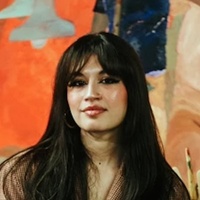
Manchester and Berlin-based experimental band Mandy, Indiana are known for their raw, disruptive energy and performances that thrive on tension, catharsis, and physicality. Their Sacred Bones debut, URGH, is available now. Alex Macdougall is the band’s drummer and Valentine Caulfield the band’s vocalist.
Conversation
On striving for physicality
Drummer Alex Macdougall and vocalist Valentine Caulfield of Mandy, Indiana discuss collaborating across countries, striving for physicality, and why everything is political.
As told to Arielle Gordon, 2498 words.
Tags: Music, Collaboration, Focus, Adversity, Process, Success.
I love your new record (URGH)—I was curious how you pronounce it.
Valentine Caulfield: You need to do the face when you do it. It’s “urgh.”
Alex Macdougall: That’s how we go. But you can do it any way you’re feeling in that moment.
Valentine: I’ve seen so many Americans pronounce the R, which I always think is quite funny.
Alex: The name came from a few things really. This record shaped up as being much more physical than the last one. We wanted to express that in the title as something quite bodily. I think last year was pretty difficult for the band. We weren’t playing so many shows, and Val and I dealt with a lot of health issues. I think it’s partly related to a bit of that. It expresses frustration and disgust at what’s going on in the world at the moment as well.
How did writing this record remotely, with members of the bands across different cities, impact the creative process for this record?
Valentine: This record was much more of a collaborative effort, even though it was still written in fragmented pieces. But instead of coming almost exclusively from Scott [Fair] when it comes to the instrumental side of things, a lot of the tracks here originated from drum beats that Alex came up with or by synth parts from Simon [Catling]. But I think we’ve always worked in a way that is pretty fragmented. Actually, we finalized three tracks while all together for this album, and this is the first time we’ve done something like that.
Alex: Working separately definitely doesn’t do away with the competing voices. We’re all quite passionate and care a lot about how it ends up. Our fragmented setup informed how the record ended up as well. It doesn’t really sound like four people in a room as a traditional band would be. That’s all facilitated by what you’re able to do long distance with technology. I actually think these limitations can bring about a different aesthetic.
A big part of this record for me was going into a rehearsal room on my own, just hitting record and improvising with certain different ideas in mind, and then choosing snippets as happy accidents. Imagine me flailing my arms about and seeing what happens… Well, no, it’s not quite as basic as that.
Then those ideas went to Scott, and he might build a section of a song around them, and then that would become a demo together with some of Simon’s ideas. And then it’s quite common that Val’s vocals will go over the top after that, but that might change the structure or the feeling of the track as well.
Val, is it a challenge to sing over shifting rhythms on URGH? I’m thinking of specifically a song like “Life Hex,” versus a more steady beat like on “Cursive”?
Valentine: I think this is going to be a very disappointing answer, but most of what I do is rhythmic, so I just have to find reference points. There’s still a track that we’ve been playing live now for two years where I still have to count in my head in places. I know that if I don’t count it down, I’m going to miss my actual starting point. Because I come from classical music and this is the way that my brain is wired at this point, I think I see things as being in specific places, even if you might not necessarily be able to get that from listening to it. So in my mind, it is completely rhythmic. Well, except for a couple of tracks here and there, and they are the ones that I struggle with the most because I need things to fall into a specific spot.
On “Magazine,” you imagine violently confronting your rapist directly. Were there any challenges you faced when writing about personal narratives like this on this record?
Valentine: I don’t think of it as a challenge to overcome. I’ve said it before, but I don’t write songs for other people. I just write about the things that I want to write about. In the case of “Magazine,” my therapist was like, “Hey, writing is a great way of channeling your anger. You could put it into words.” And so that’s what I did. But I feel like a lot of the things that I write about—well, basically all of the things that I write about—are just things that I want to be talking about. I don’t think of it as this challenge to do something that was tricky for me. I actually just got the words out that I really needed to get out.
There are some heavy lyrics here about watching the world burn. Did you intend for this record to have a political message?
Valentine: That’s just my general outlook on the world. I think it’s difficult for me at this point in time to think of anything other than the fact that we are just burning our planet to shreds and killing each other over the most trivial of things. I’m at a point in my life where if you consider yourself to be non-political, I don’t trust you. Everything we do is political. Being a woman, a person of color, a queer person existing on the public stage is a political act, whether I choose to acknowledge it as so or not. It’s things that I need to be talking about because it is what is occupying my mind most of the time.
Do you find performing this material to be helpful in processing these horrors, or is it difficult?
Valentine: Honestly, I’m not sure. It’s very fun to perform with this band and there’s something really cathartic about playing that music. When we started this band, we made the decision for me to sing in French. It was obvious that it would mean that not everyone was going to be able to understand what I’m talking about. If you look at the themes of all of the music that we have ever made, they are always the same. It’s about the state of the world. It’s about violence against women. It’s about all of these things. Playing the music, it feels great, but I’m also conscious of the fact that a lot of people don’t necessarily understand what I’m talking about.
We live in a world where people are pretty stuck in their opinions, especially if they’re not fact-based. Usually they are the hardest people to convince. So I don’t think anyone is necessarily going to listen to music like ours and be like, “Oh, maybe there is something about this.” But at the very least, I hope that we can provide a space for people who are also feeling destroyed about the lack of empathy that is around us at the moment or the state of the world burning. I hope that we can provide a space for these people to get together and reaffirm that some people still do believe in empathy and some people are still here understanding that we need to change things.
Maybe the change is going to come from effectively like-minded people being reminded that there is something worth fighting for and that we can all stand together. I don’t think that if you play our record to your MAGA uncle, he’s going to stop voting for Donald Trump.
I think that would be a really good react video though, “MAGA uncles react to Mandy, IN.”
Valentine: I’ve always wanted to watch someone burn my music.
Do you feel like speaking in French has the shielding effect that you initially thought it would?
Valentine: I don’t want to say we’ve reached such a fantastic level, but I think we’re in a place where the people who listen to us and care about us as a band are pretty aware of what I talk about because they have done the work of trying to look into it. Also, I’m not shying away from anything in interviews. I’ve been pretty open about my beliefs and the things that I speak of.
Using French for this project has also become quite fun for me. I’ve spoken mostly English for close to 15 years now. Even though French is my mother tongue, I feel like English comes to me much more naturally. Singing in French allows me to relearn how to use my own language. It also means that I have to do more work to try and pass on the emotions of what I’m talking about through the performance of the words rather than just the meaning of the words themselves. In a sense, I use words as instruments rather than just to say things in the most obvious way. Of course, if people want to look into what I’m actually saying, I’m always happy for people to discover what’s being said. I do still put quite a lot of effort into that. But I think it’s just a different approach to writing.
How are you translating this record to a live audience—it’s full of so many layers of sound, and there’s only four of you.
Alex: I think we do try and do what’s on the record live. I think our music is meant to be heard and felt live. We were talking the other day about when me and Simon and Scott went to see My Bloody Valentine recently. I’ve been a big fan of theirs for ages. Since that show, I’ve felt like listening to their records is a very vague representation of what they’re actually trying to do, and what they’re actually trying to do can only be experienced at high volume and in a live situation. I think that’s something we try and strive for live, to move people’s bodies. It’s a very physical thing. I think part of that physicality is definitely contained in the record, but you’ve got to see us live, I think, to really understand it properly.
Valentine: It’s always a fun game trying to translate the music that we’ve written into a live song because I don’t think this is something that we necessarily take into account when we are writing the music. Because it is so often written on computers, there’s always a fun few weeks before we start playing a track where the boys have to find a way to translate all of that insane music into a live setting. You can tell that none of us really think about that when we are writing because I have just written an album of songs that I physically cannot sing unless I get an extra pair of lungs. There’s three tracks on the album where I genuinely have no clue how I’m going to do this. It’s going to be a fun little kind of experiment. I think maybe if I stand very still and I don’t move and I have one of those oxygen bottles in my nose, maybe I can get through. Maybe.
Alex: Scott also writes drum parts that I then learn. He writes them on the computer as you would maybe as an electronic music producer. Then when I have to come to learn it, I somehow have to spawn a couple extra limbs in order to make it sound similar. There is a challenge there, but it’s cool because I end up playing the drums in ways that I would never choose to normally. So it does push me in ways that I like.
There is this one track on the album called “Ist Halt So,” and the three instrumentalists of us started learning that to try and put in our tour that’s coming up. We made it through one time. It’s just the most crazy thing to try and make it through from start to finish, logistically, physically. I think it’s going to be a good song live because of that, if Val can manage it as well.
Valentine: Literally, there is not a single place for me to breathe in that song. I need to learn to do the entirety of the first part without breathing. I should probably start training now. I don’t think there is enough space in my body to fill up my lungs enough to go through this entire track.
You’ve also both had very intense medical issues during the creation for this record [Caulfield underwent surgery for her eyes; Macdougall for a hernia and a thyroid issue]. How did the physical limitations of the body impact your creative process for this record?
Valentine: I would personally say that the issue with this record is that we did not allow the physical limitations of the body to impede the creative process at all. As such, we both ended up in quite sore spots. A lot of the album is influenced by the truly harrowing body horror that we both went through throughout the last couple of years. But I don’t think we really let it limit us in any kind of way, which was probably part of the problem. Realistically when you’re recovering from surgery, you probably shouldn’t be recording drums for three days.
Alex: I have reflected on this since. I feel like I’m not very good at telling when I need to rest. I went into a three-day recording session for the drums and I thought I was fine, since my surgery had been two months before. By the final day I was really pushing through on the takes to try and make it work. I don’t want to glorify any of that, but I do genuinely think that it kind of imprinted something onto those drum takes. But I don’t want to do that again.
Valentine: The surgery I had last year was my first ever surgery. I got all the way to my fourth surgery last year, which is exciting. You live and you learn. I didn’t realize how much it impacts your body. Like you said, even two months later, even when you feel like you fully recovered, it’s still lingering sometimes. It’s really tough, especially as people who struggle to not do anything. It’s really hard to really take in when your body is done recovering from everything that it’s gone through.
Guitarist and producer Scott Fair recommends:
Persona (1966) dir. Ingmar Bergman: A masterclass in cinematic language. So much evocative imagery and so much said outside of dialogue. Two all time great lead performances. Made me question my humanity and the nature of reality.
Children of the Corn - The Single: Definition of cursed music. Mesmerising.
Alex Macdougall recommends:
Anastasia Coope - Darning Woman
Outer Space (1999) dir. Peter Tscherkassky
- Name
- Alex Macdougall and Valentine Caulfield
- Vocation
- musicians (drummer and vocalist)
Some Things
Pagination