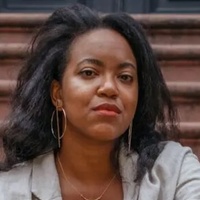
On pushing through even when you don't feel inspired
Prelude
Claudia Keep (b. 1993 in Low Moor, VA) lives and works in New York, NY. She received her BFA from Bryn Mawr College in Bryn Mawr, PA. Her small-scale oil paintings of quotidian moments are rooted in the careful act of looking. Her favored subjects—interior and exterior scenes, animals and plant life—are drawn from a personal archive of photographs, forming an ongoing diaristic documentation that preserves observations. Keep trains her eye on fleeting moments: early morning dewdrops on blades of grass, ominous clouds overhead during a moonlit drive, or a caterpillar crawling slowly along a leaf. As the artist notes, “I’m interested in trying to capture a sense of movement because I am trying to paint what it feels like to see something. I think sensation comes with movement or at least a certain suggestion of physicality.”
Recent solo exhibitions include New York, MARCH, New York, NY (2025), Somehow, Somewhere, Someway, Galerie Marguo, Paris, France (2024), In Bed, 12.26, Dallas, TX (2024), Almanac, Parker Gallery, Los Angeles, CA (2023), Aubade, March, New York, NY (2022); Day In, Day Out, Tif Sigfrids, Athens, GA (2022); Claudia Keep, Tops Gallery, Memphis, TN (2021); and Night Moves, MARCH, New York, NY (2021). Keep has exhibited in group presentations at The Carnegie, Covington, KY (2024); Château Lacoste, Provence, France (2024); Pangée, Montréal, Canada (2024); TOTAH, New York, NY (2024); SHRINE, New York, NY (2023); Cob Gallery, London, UK (2023); and Blum & Poe, Los Angeles, CA (2022).
Conversation
On pushing through even when you don't feel inspired
Painter Claudia Keep discusses the importance of practice, working with the personal and universal, and making work in the way that works for you.
As told to Annie Bielski, 2941 words.
Tags: Painting, Inspiration, Creative anxiety, Focus, Success.
As a painter, I think about painting as a site where anything can happen. I also feel that way distinctly in New York City more than any other place. Your recent show New York consists of intimate oil paintings of various scenes—the skyline, a bedroom at night, a piano player on stage, clouds over the Hudson. How did you get started painting, and how did you come to New York?
Painting is something that has been a part of my life for a really long time. I always drew pictures and was very visual, but I think my first painting as an attempt at something artistic instead of entertainment or part of a game or some story was when I was 11. I started taking plein air painting classes and that was the first time that I did observational painting from life, and I kept doing that. I was taking art classes in high school, [and continued] to take classes outside of high school up until college. In college I thought I would major in art history because I just didn’t know what I wanted to do, and majoring in art seemed so uncertain and just an impossibility. So I started as a history of art major, and then my painting professor was like, “Claudia, what are you doing? That’s such a bad decision. You should change it.” So then I was like, “okay,” and I changed it.
I really liked painting but I didn’t really see myself as doing it professionally until, I guess, after graduation. I felt lost. I moved to Maine and was working for this friend who’s a sculptor, and I hadn’t painted for a year and a half or something. He was having success as an artist, so I was like, maybe I should try doing this. And then I felt like I had to reteach myself to paint again after school.
I’m struck by plein air painting at 11! What was your landscape back then?
I grew up primarily in Pennsylvania, so it was a very Pennsylvania landscape impressionist school. So it was not formal but your standard impressionist—realist, but a little smushy. I think as a young person, so many people are captivated by trying to render something. I remember just being like, “I want to make it look real.” And then that once you realize that’s just a skill, then you’re like, “I need to make it look like my vision.” I think the benefit of starting so early was that a lot of the technical things of painting became reflexive and second nature, so then I could focus more on what I wanted to paint and the hand instead of thinking about “how do I mix this color?” Not that I don’t think about those things, but I wasn’t like, “how do I make oil paint behave?” because I had been doing that for a long time.
I grew up mostly in the easternmost part of Pennsylvania, so it’s an hour and a half away from New York. My father and mother were really into cultural things, so we would come to the city a lot when I was young. For as long as I can remember, it struck me as somewhere that made me feel really alive and really good. And I didn’t know exactly what that was, but I guess I felt part of something in a way that I didn’t where I was growing up. And of course it was glamorous and anything that I could imagine myself doing was sort of New York centric. I was like, maybe I’ll be a fashion designer, as so many young girls want to do, or work with magazines, museums, all of it. I think I just was enchanted with it early on. Then once I got into painting, that is so obviously New York centric, it became a goal to save money and move to New York and try to make it.

Claudia Keep, Central Park in the Snow, 2025, Oil on Masonite panel, bespoke artist frame, 10 x 12 inches. Courtesy of Claudia Keep & MARCH
I relate to visiting the city as a kid and feeling that way, too.
Totally. I’ve always felt oppressed in more suburban rural areas by expectation and people’s feelings of safety. New York is somewhere where I felt like people didn’t have to adhere to those things. And I guess I never had goals of the house and the kids and the car, so New York was some identifiable place where people did other things and achieved amazing things.
Now you’re painting it from the inside. Some of them feel like love letters.
Yeah, very much so. I don’t have any illusions about it. It’s also a very difficult place, and I’ve struggled here in different areas, but I think it still remains a very aspirational place. I think even though I see the things that make it difficult, I still maintain this love for it, and I see the beauty. Something I like about it also is I’ve always been very drawn to contrast and everything all at once. It’s super abject and really terrible in ways here, but then all of that misery or dirtiness or whatever is next to something that’s incredible, some amazing painting or something that’s so beautiful and luxurious. It’s painful, but it’s also so interesting to me.
Yes, and there’s contrast in the public and private, inside and outside happening within your work, and you as the painter inhabiting both of these realms, too. How do you contend with the alone time and solitude required to make your work?
I don’t know that I’m doing a good job of it. I think that’s something that’s so difficult about painting, but that’s also intrinsic to it. Both the physical act of making the painting in the studio and then also the conceiving of it and just having that time to think about it and decide what I’m going to paint. It’s difficult to contend with the solitude. It can be uncomfortable. Painting is hard and I don’t even know why it’s hard, but I think a lot of it has to do with the solitude and being by yourself and having to make every decision.
It’s not collaborative.
Yeah. I like that about painting and I do like being alone, and I like the freedom of it. But yeah, it is a challenge and I think it might be an inherent discomfort, and I don’t know if there’s anything to do about it. [laughs] Of course I try to see people and it’s nice when you have a show or something and people see what you’ve been working on in solitude.
Yes, like “oh, that’s where you’ve been!”
Yeah, exactly. That’s very satisfying and it feels like a completion of your thoughts and your work. But yeah, I think it’s just a difficult thing about it and it’s hard to describe to people who don’t experience it themselves. I don’t know, maybe it’s sick, but sometimes I feel like it makes the painting better. [laughs] Maybe that’s perverse, but sometimes a little bit of distress…gives it some poignancy, or something.
It better! [laughs]
Yeah, it better, because it’s hard! I don’t really know why. It just is. I think it’s really difficult to be generative all the time. And I think to be a painter and not just somebody who makes work when they’re inspired, is to push through not feeling inspired at all, and to do it anyway.
Yeah, what do you do on those days?
I try to have an album of to-do pictures on my phone, so if I’m feeling uninspired, I’ll go through that. Or I’ll go through my whole photo roll.
Eek!
Yeah, it’s really upsetting, actually, to relive your life over and over again. [laughs] And then when I’m feeling really stuck, I’ll return to certain subjects that I know always make me feel good for whatever reason. Painting a road is always going to make me feel good. It’s satisfying, it’s easy, it always comes together compositionally. Then there are some days where it’s just not working and I try and fail. There’s a lot of failure.
And then you go to the movies or something?
No, but that’s such a good idea.
Yeah! Go sit in the dark.
I wallow. But I should do that.

Claudia Keep, Borzoi, in the West Village, 2023, oil on Masonite panel, bespoke artist frame, 10 x 12 inches. Courtesy of Claudia Keep & MARCH
Do you have a typical routine?
Yeah, I guess it’s not super strict. But I usually get up and eat breakfast, listen to the news. Sometimes I’ll go for a run and then start painting late morning and usually paint until five or six. I’m really not a night person. I just think it’s so unsustainable and all my decisions really slow down. If I’m in the middle of something, I have pulled all-nighters for paintings if I have to, but I think it’s better to do during business hours.
I get that. I do sort of enjoy the delirium of a few late nights toward the end of a deadline.
I get that, too. It feels really romantic or something, and you feel like you have the freedom and that ability to do whatever you want. I think it’s nice to have the intensity sometimes. I think it depends on what the painting is, too. If you really know what you’re doing, I think it’s fine to work later, but it’s hard to make a lot of decisions.

Claudia Keep, Late Morning, Red and White Striped Sheets, 2024, Oil on Masonite panel, bespoke artist frame, 10 x 12 inches. Courtesy of Claudia Keep & MARCH
One thing I have noted in your work is both the specificity and generality across your titles. For instance, some scenes include the time of day, like Bedroom, 11:10 PM. But there’s also the panorama of the NYC skyline titled Cityscape.
That specificity and generality are two things I’m very interested in. And yeah, I do work all from photos I take on my phone that gives us a time stamp. I was even thinking, how I would like to attach the temperature to a picture? I wish our phones had that as a feature. I feel like I never want more features, but that’s something I would like, a time stamp with the temperature.
I’m really interested in how the more specific and the more personal I get or one gets, it becomes almost counter-intuitively more universal and more general and more relatable because my work is about the thing that’s painted, but it’s also about a person, me, seeing the thing and experiencing it. I think that my life is not really so different from other people’s lives. My experiences are shared, and I think that in that hyperspecificity, people find points of connection. You’re like, yes, on Wednesday, in February, I’ve seen the sky like this before. Or when I’m in bed at 10 A.M., this is how it looks. And I think that’s interesting, or that’s what I’ve been drawn to in other work, I guess, or just in the world.
I love that. The work is different, but On Kawara comes to mind immediately.
I love that. I think it’s a similar spirit. As painters, we’re playing on this world of known entities because we’re in culture and society where everything has a connotation, everything’s loaded. And even if it’s not specifically about something, when you put it in there, then it gives somebody an opportunity to make something out of it. With On Kawara, people want their birthday. Dates become so loaded: the day someone died or the day someone was born or your anniversary. Maybe I’ll have a feeling about something, but I think people really project things into work, and I think that’s interesting. I do the same.
Me too.
My camera roll is the closest thing to a sketch practice I have. I don’t really draw. I’m not very good at planning in advance.
In general?
In general. I’m never going to print something out or make a list of exactly what I want to do.
There’s something interesting about the speed and immediacy of the phone snapshot in preparation for painting versus the slower painting process. What is your painting set up like?
I make my work on the floor. I work at home in the second bedroom. So I have a drop cloth and the palette box that people say is too small. And then I work on panel and I’ll prop the panel on the lip of the palette box, and I sit on the floor usually on my knees and paint, so it’s down, downward over the surface. I work at a small scale, so that helps it be immediate. But I think the technical effect that I aim for necessitates painting quite quickly because I want the paint to be wet on wet, and the way I want the paint to smoosh together, for lack of a better word, needs to be all at once. So I think that speed and physical closeness to the work comes across.

Claudia Keep, Tea, 2025, Oil on Masonite panel, bespoke artist frame, 10 x 12 inches. Courtesy of Claudia Keep & MARCH
Definitely. Another thing I really respond to in your work is the limited palette.
I think coming from a foundation of plein air painting that was really heavy on impressionism, you’re taught to put color in everything and everybody’s like, “the shadow isn’t blue, it’s purple. That’s actually red, the ocean is red, and the blue is so red.” [laughs] That was such a great education, but then I realized I actually wanted to pull it way back and be so much more thoughtful. Learning to paint, I was very reactive. You’re just putting the color in as you experience it. Actually composing an image and being more thoughtful about it–to me, it’s just stronger to have fewer colors.
I think the strongest is to just have three colors and then to really reserve the color for where you need to or for emphasis. And I think it’s reductive chromatically, but also my style is reductive. I am simplifying. It’s not hyper-realism by any means. So I think it’s part of that, of reducing the composition and reducing the color to really essential elements.
I’m thinking back to your 11-year-old plein-air painting self. What would you say to younger artists?
I think you just have to do it a lot. You have to do the thing that you want to be good at a lot. And I think that seems so obvious, but it’s not. It’s practice. I think people are always like, “I’m not good at painting,” or whatever. And it’s really practice and it’s also training for your eye. The way I see things now and the way that I process an image now is a skill that I’ve practiced. You really have to look at things, and I think where you’re looking and where you’re putting your time is what you’re going to be the best at. I think in school, I felt so uncomfortable with how the professors are always like, “You have to explode this….so this is a nice painting…. so what?” Always “so what?” Which, it is good to be pushed, but having to come up with a concept feels so false. I think that maybe starting with some point of familiarity or what you like, I feel like that’s a more true way to get to whatever you’re trying to say. I don’t know if that’s right.
I went to Catholic school my whole life until I went to art school. It took me a while in art school to realize I could push back against whatever the instructor suggested. I was so used to another way.
It took me forever, and then you really revel in it. There’re so many rules that I was taught that I break now, and I guess I’m thankful for the rules because it’s a good education. I think people don’t realize how important it is to have something to push against. [Laughs] Growing up with liberal parents, for instance, you don’t realize that boundaries are really important, and then when you get to break them, you can break them in really important intentional ways.
Working from photographs was something we were told not to do, it always had to be from life. So many rules about color and size and even material, even back to the way I’m set up—it is absolutely not what I was taught to do, but it’s what works. You don’t have to have the rabbit skin glue and the glass palette–whatever works so that you can do it. Because also, nobody cares if you do it, so it has to work for you.
Claudia Keep recommends:
Henri Rousseau’s painting Surprised!
Arthur Jafa’s film love is the message, the message is death
Kate Bush’s album The Red Shoes
Gil Scott Heron’s album I’m New Here
Mixing Prussian blue and raw umber
- Name
- Claudia Keep
- Vocation
- painter
Some Things
Pagination