On making peace with your imposter syndrome
Prelude
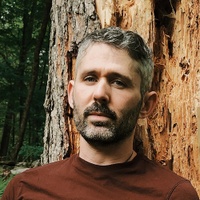
RF. Alvarez is an artist based in Austin, Texas. His figurative paintings are characterized by nocturnal color pallets and evocative scenes that blend personal memory with romantic allegory. Using a process of dry-brushing paint onto raw linen–and borrowing stylistic techniques from Old Masters–Alvarez creates luminous images of queer joy, revelry and contemplation; countering a historical narrative of queer alienation and erasure in the American West. With family roots in both Texas and Mexico, Alvarez uses visions of friendship, indulgence and tenderness to juxtapose with Southern machismo–illuminating the vulnerability that can hide beneath the steely façade of masculinity and the societies it creates.
Conversation
On making peace with your imposter syndrome
Painter RF. Alvarez discusses ambition, the double-edged sword of social media success, and how to get out of your own way.
As told to Jacqui Devaney, 2872 words.
Tags: Painting, Process, Production, Success, Promotion, Beginnings.
You worked a day job for a long time in New York and L.A., but now you’re a full-time painter based in Austin. How did you forge that path?
My mom grew up in small-town Texas and my dad is a Mexican immigrant. Making a living off of art, for me, was never part of the conversation. It just was not. It didn’t enter the lexicon of my family or even my understanding of how to make a way into the world. I went to college and studied sociology and history, which all play into my work, but I wasn’t one of the studio art kids. After, I was doing graphic design work and started my own agency. Even though it can be creative, it’s client work. I started painting—drawing, really—so I could do something creative that wasn’t beholden to someone else’s opinions.
It got to a point, though, where I reached a depression. I was so close to being able to have more of an art career, but I wasn’t able to invest enough time into my work. So, I took a leap. My husband was in medical school when I told him, “I’m unhappy and I really want to try this thing,” and he supported my decision. I’m always, still, trying to buy myself more time to paint. I just want to be in the studio, painting. And the only way that I can buy as much time as possible to paint is to sell the work somehow.
One of my biggest hurdles was overcoming my imposter syndrome, which has never gone away. I have just accepted that it’s going to be there. I actually think that hating your work is an essential part of the artistic process. It’s the only way to get better. Hate the thing you’ve done, find holes in it. That’s how you improve.

RF. Alvarez, Boats Against The Current, 2025, 48 x 48 inches.
You didn’t go to art school. Can you talk about how you learned to paint and how you found your voice as a painter?
For a while, I thought I wasn’t going to be able to be an artist because I didn’t go to art school. That just simply isn’t the case. It’s always been about working and working and working and working through the bad stuff until I get to something that feels worth pursuing. The work at the beginning of my career was totally different from my work now. It’s fine, I don’t love it. It was simple in so many ways, but that was the work at the beginning. As soon as I got over myself and was able to put work out there, I was able to develop as an artist. But, I’m still working through it.
I didn’t start off with the expectation that I needed to have the angle and I didn’t start off with the expectation that I needed to follow all the rules. With anything in life, you don’t have to follow the rules. Having something that you need to get off of your chest or having the hunger to create is enough.
You began your career as something of an outsider, at least in the art world, which seems fitting in a way. Your paintings are heavily invested in interrogating the idea of being an outsider. Not only in Texas, but also in your family.
Yeah. I grew up under the shadow of a grandfather who was a cowboy and then all the Mexican machismo on the other side.
And now, as an artist, you’re trying to make sense of all of that.
That’s right. It’s funny, the act of making art. I don’t know if it’s that I have something to say and then I go paint it. Actually, I feel as if I’m a conduit between something deeper in me, some bigger thing, and my own realizations. The pathway of understanding what I’m painting about, or who I am and what I’m trying to work through, comes from the painting to me, not the other way around. I feel like a lot of artists relate to this. It’s like it goes through me and arrives at the painting, then I look at the painting like, oh shit, this is the thing I’m unpacking.

RF. Alvarez, A Picture of Us, 2025, 24 x 30 inches.
It really started when I moved back to Texas. I was gone for ten years and when I came back, Trump had just been elected the first time. I hadn’t unpacked why I’d left in the first place and what I’d left behind. My work has now become the act of unpacking that. It’s been about trying to understand who I am within a bigger context—of family, of the place I’m from, of the country we’re living in. What does it mean to be an American right now? That’s on my mind. I’m trying to understand myself through the act of painting.
Even though the theme of being an outsider is important to your work, a lot of your paintings depict deep love and tenderness.
A lot of my work is cinematic in inspiration. I’m interested in how directors or cinematographers frame a scene and what’s outside the frame. For me, a lot of the time, the work is not necessarily about what a viewer is seeing, but about the greater world that exists outside the frame. To create a very quiet, intimate scene in a home, a place that’s a hearth of belonging, between two men, like my husband and I, within a Texas landscape, a place where legislation against sodomy was first enacted, shows what it means to have light in the darkness. I find that a much more interesting, compelling, narrative than if I were to just punch you in the face with it.
Can you talk more about how the Texas landscape plays into your work?
It’s a harsh landscape. The weather passes through so fast. It’s so capricious. My husband’s a gardener and it’s impossible to keep something alive. You never know what’s going to happen next week. And I find that a very appropriate metaphor for exactly what it means to thrive here under these intense conditions.
You never know what’s going to happen.
You never know what’s going to happen. Not to say that we’re an authoritarian state in Texas, but there is this question of, is the bottom going to fall out at any point? Is the storm coming?
Is it coming?
I have painted a lot more works about oncoming storms lately.
Like Turner?
I’ve been looking at Turner a lot. I tried to do a Turner-esque nightscape with the storm in front of moonlight, and it just fell apart on me. I want to revisit. Again, this is how the process of painting works a lot of times for me. I didn’t nail the moon with the storm. I want to try it again. Now, I’ll give it another go. In the process, I will probably find that there’s a deeper narrative going on within that composition, but at this point I’m leaving it up to whatever happens.

RF. Alvarez, Gimme Shelter, 2025, 60 x 72 inches.
For a while, you invested heavily in cultivating a following online, which you described as buying time. Can you talk about your relationship to social media? What was it in the beginning? How has it evolved?
In one word, toxic. It’s this wild beast that I’ve had to do some sort of dance with. Even still, social media has allowed a lot of artists, like myself, to build a following outside of the normal art world gallery system. At the time when I began, social media was a way that I could reach people with my work. Quitting my job to do art full-time coincided with the beginning of pandemic and I realized that everyone was looking for solace and central nervous system calming things, so I thought, “one thing that people could really use right now is a nice, quiet video of someone slowly painting a painting.” For me, painting is a meditative act, so I decided to get over myself and start sharing my work through social media. So, that’s what I did. And it ended up being essential. It helped me be able to move into a studio, work with bigger galleries, and give me the time and space to improve my craft.
But, it came at a price. I had to get rid of TikTok, because it was nearing an addiction. And I had nearly 80,000 followers and was pulling in all of these potential collectors, so it felt exciting and delicious. Then I was spending six hours a day on it. I wasn’t painting. I had to get rid of it.
I’d love to get off social media altogether. I envy artists who are able to not be on it. But, I recognize that it was essential at the beginning of my career. But, it has changed. Instagram is now basically just an e-commerce platform or trauma porn.
Then we inject AI into the mix.
And now AI. Like fuck me, get me out of here.
What’s it like to ascend in the art world? You started as an outsider, and maybe you still feel that way, but you’re doing shows and getting high-profile coverage.
I feel a little bit like the dog that caught the car. I didn’t think it would all happen so fast. How do I talk about this without sounding trite? I started my full-time painting practice, because I was just craving more time to paint. I wanted to be working at bettering my ability to communicate using this medium. And I have arrived at a place where I’m now working with galleries that I very much respect and am excited to be working with, who are doing incredible work for me. I’m even taking interviews with galleries who are pitching themselves to me. That’s a fucking insane thing.

RF. Alvarez, The Secret Language, 2025, 36 x 48 inches.
In all honesty, I have no idea what to do with myself. I’m taking it day by day. It’s a funny thing, how life works. You have this dream of where you want to end up and one day you wake up there. I think it can be really easy, or maybe it’s just human nature, to take what you have for granted. It’s easy to lose track of that. That I’m currently living the dream that I once had for myself.
When you decided to quit your job and do art full-time, did you have a plan?
I had enough savings for two months. I’m lucky that I have parents that would’ve supported me if I really needed it, too. That’s important to acknowledge and be aware of. I have a family infrastructure of people who love me and would help me get back on my feet. But, I did it on my own and I’m really proud that I did it on my own. Since I only had two months, I really had to start selling shit right away. I kept my overhead really low in the beginning. I was working out of my house and mostly doing sales through social media. I took a lot of commissions. Interior designers were an important first step for me. So, I pitched myself to them and that was a good early step in making money with my work.
One thing that strikes me is that you have this resistance to being one thing. You are a painter, first, but you also do collaborations in other worlds, like wine, fragrance, and food.
It’s fun to do something different. I think I went into this not wanting to be defined by other people’s expectations of me. I’m just trying to just have fun with it. I don’t know that an artist has to be one thing, and I like the idea of the modern artist doing other stuff. In the fall, I’m doing a three month residency in London and I pitched that I wanted to write a play. At some point, I want to make a film. I want to open a restaurant. I want to write a novel. Who knows? I don’t think we should be confined to one thing. When I was younger, I had all this long list of things I wanted to do, and I remember sitting around with a friend, having a drink, and I was like, “Well, I don’t know if I should do this or this or this.” My friend was like, “Robert, shut up and pick one.”
What do you do when you’re not painting?
Cook and drink.
What else is there?
Exactly. It’s funny, when I was doing graphic design, painting was the thing that I did for myself to be creative and explore. There wasn’t any external pressure on it. Now that painting is the thing that I do for a career, it now has to tango with that external pressure. So, cooking has become the thing. I love to throw a good dinner party.
And you paint them.
I threw one last weekend and the weekend before that. It’s a lot of dinners.
Home and space are important to you.
Essential. Even more than trying to unpack queerness or trying to unpack Texas heritage, my work is about home finding. It is about finding and understanding the concept of home. The home that I have, that I share with my partner, is the most sacred of spaces to me. I was a child of divorce. My parents split when I was 11 and I was passed back and forth between these two households. I was living out of a suitcase for so much of my life. Now that I have it, I feel so lucky and I cherish it. It’s important to me.

RF. Alvarez, Two Step In The Kitchen, 2025, 48 x 60 inches.
If someone said to you, “I want my life to be like yours. I want to be an artist. I want to quit my job.” What would you say?
Get out of your own way and get to work. For me, the thing that was the hardest hurdle to overcome was getting over the fact that I wasn’t producing the work I wanted in the beginning. Just like that Ira Glass quote about having taste. I had these expectations I wasn’t going to meet. I didn’t think my work was good or worth it. I wish I had realized earlier that it’s not something I can overcome before doing it. Style naturally comes out of the work itself.
So, I would say work and work and work and work and work. Enjoy the act of working and then figure the rest out after. I think the mistake that artists make is that they make one artwork and think that one piece of art is enough to propel them to fame. But it’s going to be hundreds of pieces down the road. You have to really love what you’re doing. Just work and work and work and enjoy the work.
RF. recommends 5 things his kitchen pantry cannot exist without:
I recently took a trip to Athens and was blown away by KYKNOS tomato paste. It’s perfect for building a soup or sauce (You can just add it to a pan of sweated shallots, splash of white wine, and you have a beautiful sauce) or even spooning into pita.
I make artworks for the restaurant King in NYC a lot, and they turned me onto this fabulous olive oil from Tenuta di Capezzana. It’s extremely well-balanced, aromatic, fresh. I drizzle it over everything from lettuces to ice cream, swipe it with garlic toast and eggs in the morning. I consume a lot of this stuff.
My favorite red wine vinegar is from Portugal–vinagre tinto–and I use this one in salads and to marinate tomatoes and for anything else that needs a dry tangy punch of flavor. Herdade do Esporão is my go-to.
The best dijon for your money, in my opinion, is the Edmond Fallot Dijon. But I’ve been really into its cousin, the Moutarde de Bourgogne, which is a bit softer with Burgundy mustard seed and the addition of white wine. It’s great to build a simple dressing when combined with minced garlic, pepper, salt,, the aforementioned red wine vinegar, and slowly stirring in the aforementioned olive oil). Make it, lick it up. Thank me later.
Lastly on our tour across the Mediterranean, the best anchovies come from Spain. Cantabria, to be specific. A couple of Americans started importing them under the name Donostia and I think they’re fabulous. Toast, butter, a few of these bad boys…heaven.
- Name
- RF. Alvarez
- Vocation
- Painter
Some Things
Pagination