On the creative power of vulnerability
Prelude
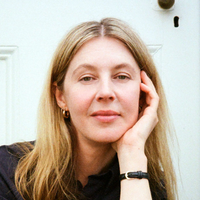
Polina Ganz is a 22-year-old photographer living and studying in Paris. Growing up in Berlin profoundly shaped her work, guided by the raw essence of West Berlin’s avant-garde. Polina’s work is a modern cabinet of curiosities, where each photograph is an escape to a world of imagined characters. She began her studies in London and initiated her journey into photography by attending queer raves, fully embracing the camp and underground culture surrounding her. Her work has been presented in a range of international group exhibitions in Paris and Berlin and featured in publications including Fisheye, Foudre, DéPaysants, 7879 Mag, Initial, and S&M. She published her first solo zine, “I Dream In Grey,” last November. Her most recent exhibition, “A Dream That I Can Still Remember,” showed at the Bastille Design Center in Paris this May.
Conversation
On the creative power of vulnerability
Photographer Polina Ganz on dream logic, putting androgyny on a pedestal, and the eerily conflicting fear and freedom of endless possibility.
As told to Erin Evans, 2404 words.
Tags: Photography, Collaboration, Inspiration, Process, Beginnings.
How has your formal education in Paris changed your artistic practice?
Before I started doing my bachelor’s in fine art photography, I took photography less seriously. It was more of a hobby.
I also learned how to speak about my work. Since my photography is pretty specific, it’s sometimes hard for people to understand where I’m coming from.
What has learning to talk about your work helped you understand about it?
Something that seems obvious to me is not necessarily obvious to the observer. And explaining the obvious is hard, especially if it’s something that is so deeply rooted within a person. Getting to these roots that are my not visual references but things that I’ve experienced, that are subconscious, something that I’ve been carrying for years but have never expressed. Maybe it was hidden away, very subtle, but somehow it came through and became vulnerable. I think the state of vulnerability is where you start understanding yourself better.
When you present your work, sometimes someone notices something that you have not taken into consideration, and you’re like, “Oh, this maybe was not accidental. Maybe it’s supposed to be there.”

from A dream that I can still remember
What is something that someone else noticed in your work that you had not noticed?
I have always worked with black and white. This exhibition is the first time I’m exhibiting color. I had not thought about the reason why I used black and white. It started when I shot on film. It was the only thing at my disposal. When I started shooting digitally, I stuck with black and white. But people kept asking me, “Why is it so dark? Why are your images so dark?” To me, black and white did not equal darkness. It was just unsaturated, very stripped to the bone. But since people of different ages and backgrounds had said that, I started to think: Why do my photos have this kind of eerie feel to them? That was an interesting conversation with myself. I don’t even want people to think that my work is Gothic because I don’t see it that way.
This project marks a revelation from being stuck in this space of black and white because I didn’t dare try color. But I think I needed to be brave.
You’ve said that you intend to put subculture on a pedestal with your photography, and I’m wondering how that became interesting to you. Are there particular subcultures that primarily interest you? What do you see as the value of putting that on a pedestal?
In London, when I started my informal studies, I would go to raves and photograph all of these beautiful people with my point and shoot—super documentary, very fast—and it was mostly queer communities, people who were so extravagant and unique and on their own, very independent. That subculture stayed with me. I always reference the LGBTQIA community in my work.
This project is about androgyny. It puts it on a pedestal as something that is beautiful. Since androgyny is a state of wholeness to me, it presents it as something that one should aim for.

from A dream that I can still remember
I like what you said about androgyny as a state of wholeness. I agree with that, although I haven’t put that word to it before. You also brought the idea of childhood into this exhibition. Was that to bring in more of a softness, or why did that become interesting to you?
This exhibition is the first time I’m working with something personal. Prior to this project, I would work with stories that I’d heard or things that I’d observed, referencing things that are not attached to my own experience and personality. This time, I wanted to integrate something that I’ve experienced myself. I always have been pretty androgynous in my mind and in the way I look and dress. As a kid, I was my most androgynous. As a child, there is so much possibility, and you don’t have any assigned roles—you’re not aware of them—you know so little of the world that everything seems like a possibility.
That is childhood: a young person is androgynous because they have this sense of acceptance of everything that they could be. I broke this barrier of being scared of working with something deeply personal. I think it’s a vulnerable realization, that you’ll not be able to access your childhood again. But preserving that sense of wonder is something that I would love for everyone to try to do.
Would you describe this exhibition or your work in general as surreal?
I don’t think necessarily surreal, but definitely dreamy. I think what’s so interesting in my work is that it defies logic. Since I construct these meticulous worlds, the observer wonders where these characters came from—what are these objects? What are these places? It all seems like a fairytale. This project also drives a lot from fairytales that my mother told me when I was a child, whose characters exist within a world that is so huge, but so easy to tame.
I’m reading a book right now called The Uses of Enchantment. It talks about how important fairytales are in helping a child to understand the world, to be able to be brave and go about their day without being scared. The feeling of possibility in fairytales, where you can solve things yourself, has also [interested me in] the past couple of months.
I think dreams are such important concepts in our lives because we can’t explain them. They stay with us for so long, and [they don’t] necessarily need to have an explanation to have a purpose and to matter.

from A dream that I can still remember
Has the idea of dream logic been important to your work before?
It’s definitely been with me. My photography is staged; I think it’s interesting to stage something that doesn’t exist except within my mind and within the mind of those I work with. It’s the state of in between. And I think photography itself is the state of in between because it is so fleeting. That’s why I find this medium the perfect tool.
I also wanted to ask you about the fact that your work is staged. When I think about how we generally photograph subcultures, I picture candid shots that people are taking often without the subjects’ awareness. Has your work nearly always been staged and stylized, or why did you start doing it this way?
I started off in documentary. I created a book called Mise-en-Scène about all these people that I encountered in London over a year. It’s about 120 images, all shot on film. When I started my official studies, I realized that I could stage photos myself, and I’m in control, I’m in charge, I’m the one deciding who is going to be in front of my camera. And since I also want to work in fashion—in a more editorial [capacity]—it came naturally that I wanted to cast people who perfectly fit and who had stories to tell that aligned with my ideas.
I like to know what’s going to be in front of my frame, and I love to take time to construct it. When you shoot documentary, obviously you have to be really fast and immediate. It’s my little treasure, [that] book, it’s where it all started—the roots—and I always go back to it. It is something unique, and it will never happen again.

from A dream that I can still remember
I was curious also how you find the people who you cast in your photos and specifically how you found the models for this most recent exhibition.
My models are mostly friends or people I found on social media. For this project, I cast people that I’ve already worked with, but generally I’m trying to find new people who would love to share their stories with me. It’s always a collaboration, and I love finding out what the person has to say about androgyny and about the kind of stories I’m telling with my work prior to the shoot. I don’t want to impose anything on other people, and if they don’t feel aligned with what I’m going to be telling with the images, it’s not a match. I explain the characters that we’re going to be working with, and I look at the characters as if they’re mirroring the personality of the people that are going to be in front of the camera. I see, [for example], if a person is more dominant or a little bit more shy, [and I adjust] their characters to have those feelings and features. It’s more natural, and the models feel safe and have fun.

from A dream that I can still remember
So the characters you’re creating change after you’ve talked to the models you’re using?
Definitely. It’s interesting to see that flow of energy, how a person feels themself in the space or in the garments, or what they have on their own mind; maybe they’re going to create their own story, and I’m just giving them guidelines.
Besides having that conversation with the models beforehand, are there things that you have found particularly effective for working with models?
A lot of people share stories[with me of not being accepted as they are in their families. When we create something together, they feel more aligned with how they want to be seen and how they feel within themselves. For just two hours, they become their better self, let’s say, at least visually.
That’s something close to my heart. I want exactly this kind of feeling, not only from the models, but from the people who will see these images and have this feeling of endless possibility.

A theft of essence E.E SS26 II
I saw in the description you sent me that you wanted this project to evoke the sense of the time in life when everything felt possible. But it feels like there’s this eeriness still in these photos a bit. They are dream-like too, but it was interesting to me the combination of those two different moods: when everything is possible, but it’s not perfectly idyllic.
Endless possibility on its own does evoke fear. It’s so vast and so grand. You can get scared, especially as a child. As an adult, you know that certain things can’t be possible, and that’s even scarier. That’s where this eerie, uncanny feeling comes from. We worked with an amazing set designer, Isabelle Clotten. We [collected] all these pieces that seemed a bit off scale or broken or misplaced in the room. [They provoke you to wonder], “Why is this here?” [Or], “I understand why it’s here, but I can’t explain it.” The styling, also—we worked with Anthony and Alice in Berlin and Paris, and they did an amazing job using these garments to [make] something feel a little bit off. It looks beautiful and it’s very sleek, but at the same time, something is wrong.
How did you find the stylist and set designer, and what was working with them like? Is working with stylists or other artists something that you do often in your work?
I worked with Anthony Goetzmann and Alice Kister. Alice is from Berlin, and that’s my place of origin. Anthony is from Paris. I’ve worked with them already many times. For this project, I wanted people who truly know my story and are my friends. They also contributed so much to my practice over the past three years; I wanted to work with people who already had a place in my world of production.

Mäntig Morge, Mercredi Soir I
What is your collaborative process like with these people?
We start thinking about the project together. We’re always bouncing ideas off each other. Since we know each other’s preferences, we don’t need to explain ourselves; it’s a lot of trust. It’s interesting to see what others have to say about something that was at first just mine. I love when they have suggestions that I would never [have thought] about.
How did talking to these people or working with them change this particular project?
The project is divided into two parts. One is situated in Berlin and one in Paris. Berlin is this forgotten space that is very dusty and very… it’s a scene that feels abandoned. Paris is more colorful and bright, very in your face. It has all the elements that we think of as childish. What Alice suggested is to make the styling very muted and toned down, as if the colors have faded.
Anthony, for the styling in Paris, suggested using a lot of patterns to imitate the room, as if the models are part of the room—they’re coming out of the walls. It becomes this single organism. And Isabelle, the set designer, was really creative. She created this puppet. It was a stuffed animal, but it was based off a children’s drawing—like how kids draw in a chaotic way—patched together out of fabrics that don’t go together. And it was huge. It was two meters [tall]. I’m glad that I could create this team of people who had something to say and were all in sync.
Polina Ganz recommends:
Room to Dream, a 2018 memoir by David Lynch and Kristine McKenna. This is one of my favourite books.
Walk Through Walls: A Memoir by Marina Abramovic. This memoir spans Abramović’s five-decade career and tells her life story. It is the strongest autobiography I have ever encountered.
The work of Puck Verheul, an amazing photographer, archivist, and printmaker.
Schwules Museum Berlin Library. An amazing hidden library in the heart of Berlin with great literature on topics I work with.
PERMSKY KRAY, a post-punk, synth-pop, and Soviet-wave project by a Russian musician. The most sincere music I have ever heard.
- Name
- Polina Ganz
- Vocation
- photographer
Some Things
Pagination