On cultivating talent in yourself and others
Prelude
Glory Edim is a literary tastemaker, entrepreneur, and advocate for diverse voices in literature. In 2015, she founded Well-Read Black Girl (WRBG), an online platform and book club dedicated to celebrating the works of Black women authors and creating a supportive online community for readers. Under Edim’s leadership, WRBG has grown into a nonprofit organization, hosting events, book festivals, and author conversations that highlight the richness and diversity of Black literature. Her efforts have earned her accolades such as the 2017 Innovator’s Award from the Los Angeles Times Book Prizes and the Madam C.J. Walker Award from the Hurston/Wright Foundation. As an author herself, Edim has contributed to the literary landscape with her bestselling anthologies Well-Read Black Girl: Finding Our Stories, Discovering Ourselves, and On Girlhood: 15 Stories from the Well-Read Black Girl Library. In 2025, she launched the Well-Read Black Girl literary series with Liveright books. The second title in the series, I Hope You Find What You’re Looking For by Bsrat Mezghebe was published in Feburary 2026.
Conversation
On cultivating talent in yourself and others
Writer and entrepreneur Glory Edim (Well-Read Black Girl) discusses small beginnings, keeping your mind open to possibilities of success, and why it's empowering to develop community.
As told to Brandon Stosuy, 3357 words.
Tags: Writing, Business, Collaboration, Inspiration, Family, First attempts, Time management, Failure, Day jobs.
I’m curious about your journey in establishing Well-Read Black Girl. When you started it, you were working at Kickstarter. We worked together and you’d tell me about this idea you had when we’d get lunch together. I remember you launched a Kickstarter campaign for a conference around it. Then, at least to me, it seemed to really take off. But when did you first see it really growing? When did you know it was time to leave your day job and pursue it full-time?
Oh, gosh. It’s interesting to think about and reflect and just have these memories with you because at the time when I was building Well-Read Black Girl, I did not know what it was becoming. It was really, truly something I just enjoyed. I was reading, I was meeting new people in Brooklyn. I was trying to figure out who I was in this new space. I’d always wanted to live in New York and I found Kickstarter to be a dream job, where creativity was paramount. You could do anything.
It just made me feel more confident. Looking back, I think that confidence was a little naive. There was a lot of things I just did not know, but because I had the ignorance, I just went full force and did it anyway. It’s amazing to not be afraid of the risk. I just felt like I had the audacity and the privilege of trying to reach for my dreams and if I didn’t “make it,” It would still be okay because at least I tried.
I was also doing the responsible thing of paying my bills. I had a full-time job, so I could just be creative and ask questions, and I was surrounded by so many incredible writers and artists. The first person I invited to the book club, her name is Naomi Jackson—we’re very good friends now, both of our kids are the same age—I remember going up to her at Greenlight Bookstore and simply asking her to come to my book club and showing her my Instagram page when it probably had less than 75 followers. There was no reason for her to say yes, but we were both in this place where this was her first book and this was my first time trying to host a book club, and she just said yes.
That has been my trajectory towards success. People being able to invite me into their spaces and finding the creative work that I’m doing inspiring and us mirroring each other. It was really just friendships and growing and it all snowballed. I never had a business plan. I never tried to pitch this to a VC. I had no plans of that and I have been really fortunate. It just feels like the best of luck has fallen on my creative journey, and I try to tell people that’s what it takes. It’s hard to articulate that … It’s hard to articulate it because it just happens.
One of my favorite poets is Mary Oliver, and she has this poem called “Evidence.” Have you ever heard it?
I know Mary Oliver, but I don’t know that poem, I don’t think.
There’s this line in it where she says, “keep some room in your heart for the unimaginable.” I do my best to just keep room in my heart for things that I can’t see, that I can’t imagine. I’m always looking for evidence. Like, good things are going to happen, especially when things get challenging and then hard and the creative juices aren’t always flowing or there’s writer’s block.
I have to stay open to the possibility that something better is on the other side of what I’m working towards, and that is what has sustained me as a writer and the author and Well-Read Black Girl as a platform. I keep dreaming towards something bigger and believing it’s possible because I’ve seen it happen in other areas in my life, so I’m like, “Okay, I know it can happen. I just have to stay consistent.”
That’s probably the biggest thing I tell people now. Especially aspiring writers, I’m just like, “You just have to keep going and be persistent and be able to say that even if I get a no, if I face rejection. It’s okay, I can still move forward with this because I believe in myself and I don’t have to seek out external validation.” That has been the ongoing pathway.
I think once I got my book deal, that was probably the thing that made it certain, because I had an agent, I had my editor. I remember when I got the email, I was actually at the office. I thought it was a scam. I was like, “Are you sure? You want me to write a book?” I hadn’t even thought about that. I was so invested in being an advocate and being a reader that I hadn’t really thought about writing my own book. But I did go to school for journalism. I knew I could write, but I didn’t think about it in that way. Once I was unlocked and I was like, “Oh, I can do this.” I can actually build my livelihood of just being a creative person this way, it was full speed ahead. I just wanted to go forward and keep doing it forever and that’s where I am now.
I left Kickstarter in 2018. Since then I’ve published three books. My memoir came out in 2024, and now I’m editing, and I was able to work in partnership with Liveright to publish two new books that just came out last year and this year that are all my imprint. So it’s like book club, the book festival to now literary imprint, which is wild. I could have never ever imagined that happen.
I’ve had dreams and no money at times, and I’ve still been able to be creative. I’m always trying to find ways to just push that forward and help people see that creativity can be both deeply personal [and] be communal. It’s a thing that we do together. I’m always pushing against this idea to be a true artist or to be some genius, you have to be in solitude and be quiet. No, you should build rituals. You should do things together. You don’t have to create in isolation. You can do things that are authentically loving and community driven. That’s really the ethos of everything I’m trying to build, that creativity and community go hand in hand.
I feel the same way about community, and if someone reaches out and I can offer them help, I think, “Cool. Why not?” It doesn’t harm me, and maybe they have something come from that exchange. I remember being young, writing to writers I liked, and if they wrote back even a sentence I was over the moon. The smallest gesture was important to me.
That’s something that people don’t always realize: It’s important just putting yourself out there. You can’t have a perfect strategy. Sometimes a project comes together because of the weirdest luck. You run into an old friend in a store, or whatever.
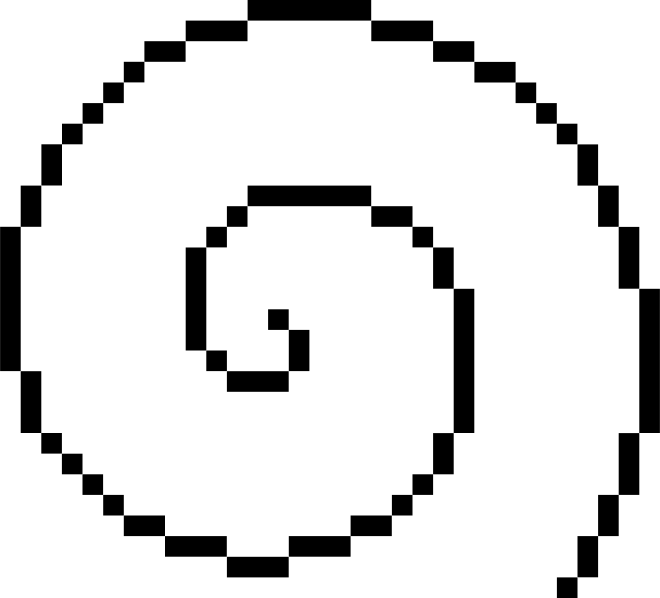
I think people often assume the creative path is straightforward. Like, you have it all set out and it just goes smoothly from one spot to another. But so much of it is a surprise, and it’s having a belief in an idea, then just sticking with that belief and seeing what happens. Even if the path is winding and confusing. I mean, there’s a reason why TCI’s logo is a spiral.
I agree with that. I do feel like when artists and writers gather together, whether it’s in a book club or at a concert or at a museum, even online spaces–everything I’ve really truly built has been this balance between online and in real life–but it’s like you said, it’s sharing that work and having those conversations where people feel safe and they can experiment with ideas. And you can say, “Let’s try it.” Again, even if it doesn’t work, you still have the relationship that you’re building and that’s evolving or you have some incredible insight and you learn from it.
I truly believe that nothing is wasted. Even like this, us having this conversation now and reminiscing about our time at Kickstarter, that’s valuable and not because we’re doing this interview, but because we had a shared experience and we have good memories together. That is part of it. Now that I’m a mom too, I think that another part of my artistry is just learning how to have greater attention and to teach him how to pay attention to the little things that are meaningful. I don’t know, I think it’s also the only real power we have against all the things that are happening in the world: paying attention and speaking up and knowing how to advocate for yourself and others.
I think that is artistry, but it’s something that has to be modeled. The things that I’m trying to show my son, I have to model that for him. So we paint together and we read out loud and when we go to a museum, I’m like, “What do you think of that? What’s your favorite color?” I’m trying to help him shape his identity, but also his own creative vision. [To] nurture that in a way where he can stand on his own. Just cultivation: I think each individual person needs that as a child and as an adult, you don’t stop doing that just because you get older.
But in this grand idea of how to be an “artist”… I think like you said, people feel there are rules to it and it has to look a certain way, and that’s not true. It’s completely unconventional. It often takes years of community building. It takes so many conversations to truly know. Conversations with yourself, to know who you are and build a level of self-trust and keep going despite things being difficult.
I feel like I’ve had greater creative success in my professional career, and I’ve had a lot of challenges in my personal life where I’m just like, “How are these things not working out the way that I want them to?”
But I’m trying to close that gap with love, despite things not always meeting that expectation. I’m thinking about what you said earlier, that creativity requires witnesses. You need to have someone see your work and critique it and experience it, engage with it in order for it to reach its fullest potential.
When I was younger, I remember I’d always have this idea of the creative genius holed up in their home, working in solitude and spending 10 years on one thing. Sometimes things happen quickly and some things take a little longer. That said, I don’t find it useful to focus on just one thing… I enjoy having a few different projects—not even juggling necessarily—but just having the momentum of different things is useful.
I found, for me personally being a parent, that my time management got really on point where I’m like, “Cool, I have this amount of time to get this thing done. I’m doing it.” Just diving in. Have you found that to happen with you?
Oh, yeah. Absolutely. It made me realize how much time I wasted previously. I had a lot of free time that I probably might not have been utilizing to the best of my ability, but whatever. Now it’s like, okay. I’m waking up at 6:00 AM to make sure he gets to school by 8:00 AM, and then it’s like he’s done it 3:00 P.M. What can I do in between these times that aren’t only emails? Because I don’t want to get bogged down by the logistics of the operations of my business. I want to actually have space to take a long walk and read something and reread it, sit with it and think about it. It’s a wild thing that parenthood changes your relationship with time.
It made me also think that there’s no difference between developing “real work,” and having a passion project. It could be all the same. I’m going to work on my garden, but I’m also thinking about this paragraph and editing in my head or working on this interview. It’s all interconnected and not separated, and I actually prefer it that way because it’s like I’m not clocking in and out. I’m just living my life and enjoying it to the best of my ability. I’m always trying to look for the joy in things.
I’m not afraid of no, because all you need is one yes. I have three books have been published, one’s coming. I have a fourth one coming that I’m working on now. That I kept submitting and people were saying no to it. I’m like, “I’ll submit it somewhere else. It’s okay.”
I guess people don’t realize either is that you hear so many No’s. The stuff that I’ve done, too, same thing. You just have to find the one person that gets it. There will be some Yes’s, too, where the people clearly don’t get it, and you’re like, “All right, maybe this is not the right Yes.” There’s way more No’s than there are Yes’s, and when you get those moments where the agent writes you back and says, “So here’s what we went out with. These 10 have said no.” You’re like, “Oh, really?” But they’re like, “This one person said yes.” And you’re like, “Oh, wow.” It can take time, but you just need to find the one right Yes.
Yeah, exactly. And even the No’s, it’s just information. It’s just a way to figure out how to refine what you’re doing, or how to articulate your work in a way people can understand.
Because I started so much of my creative career online because of the Well Read Black Girl Instagram, its popularity and the visibility, I feel like I am in this space right now being an editor and working with other writers where I’m going back to the foundation of what it means to be a writer. In that way of doing things intentionally in community, but quietly, not necessarily sharing it online. There’s so many things I’m doing with friends and other collaborators that I’m not putting on Instagram because I want some space to work it out and just have conversations.
I love digital spaces, but sometimes they don’t have enough space for nuance. I’m going back to basics in a lot of ways, where we’re not posting it online. I’m editing. I wish for every writer to have someone be a cheerleader and to champion them that hard. Just be like, “You’ve got this. You think you might not have it, but you do.” It’s been so, so freaking awesome.
I think having an editor that you trust or collaborator is so important. For me, it’s hard to do stuff entirely alone. As your project has grown, do you have a team? How much are you doing on your own?
Yeah. I have these two worlds… When it comes to the editor Glory, she works with the team with Liveright and I have co-editor. I have a publicist I work with. We have a marketing team. I really am linked and very tied in with Liveright and they are an incredible publisher. They have the energy and feel like a big five. Traditionally they’re a co-op and they have this very DIY, grassroots internal team. We are close, we have emails, we text each other and then the authors are looped into that. So we’re constantly talking to each other in a way that’s not overwhelming. It’s really collaborative and nurturing and loving. It does feel like we have this camaraderie that happens among us that’s very genuine and endearing.
When I wrote my second book, at the time, I was very obsessed with thinking about youthful voices and what that means to be a young Black girl. So I did that. That book came out during the pandemic, so it didn’t get as much traction and it was really a love project.
But during that time I was working closely with Gina, she was my editor and I brought up the idea that I wanted to do Well-Read Black Girl books. When I talked to her about it, I was thinking years into the future because my insecurity at the time was, I can’t do this just yet. I want to go back and get my MFA. I want to do a PhD program, and then I’ll revisit this in a couple of years and present myself as an editor.
And she was like, “I’ll help you. I will teach you how I edit. We can do it as a team. We’ll be co-editors. I’ll show you my notes. We can query authors together and writers. We can talk to agents, we can do it together.” And that was the first time where I was like, “You mean now? I shouldn’t go back to school?” She was like, “No. I’ll do it now.”
So we figured out what the collaboration would look like, what that partnership would be, and we launched in 2022. The first book we acquired was Yrsa Daley’s book, The Catch. Yrsa and I built our friendship through books. I supported her when she wrote her poetry collection, bone. When she wrote her memoir The Terrible. She came with this manuscript that was just out of this world. It was just good. I was like, “I don’t think we need to edit.”
Gina taught me so much. I feel very confident doing nonfiction and doing interviews, doing traditional journalism, but with fiction, there [were] just so many questions I was unaware of. I understood deeply as a reader, I know what I feel. I am a mood reader. I feel for the essence. If I’m weeping during your book, Pulitzer Prize. But she taught me more of the technical skill set of pacing and plot and structure and understanding sentence by sentence, and we continue to do that to this day. She truly is the primary editor, but we’re doing it together and she’s teaching me.
I’m forever grateful for that relationship and being a student with her and her just appreciating who I was and how I learned. My pathway into publishing has been more unconventional than the average person, but she has trusted me and now we have these two amazing books, and [amazing] reception from the outside world. I was like, “I know these are good.” But to hear the New York Times co-sign that, it just does feel so, so good.
I think when I was first starting Well-Read Black Girl, the reason people really resonated with this idea is just because I was genuinely enthusiastic and showing appreciation for their work. I saw myself on the page in a way that I hadn’t seen previously. People can see when you’re being a sincere and honest person. People want to hear that, especially artists. Like, “Hell, yeah.” You want to hear like, “Your book moved me or made me feel like a certain way. I see my voice in it, my childhood in your words.” That is the greatest reward I think you can receive as an author that people really see themselves in your work and we can’t take that lightly.
Glory Edim recommends:
Follow Glory’s Substack focused on craft and creativity
Read: Octavia E. Butler, “Positive Obsession”
Listen: Discussing the life & work of Maya Angelou with Nikki Giovanni
- Name
- Glory Edim
- Vocation
- writer, entrepreneur
Some Things
Pagination