On preserving your sense of play
Prelude
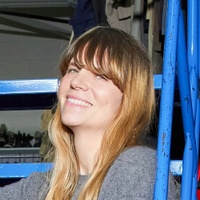
Katie Yee is a writer from Brooklyn. She has received fellowships from the Center for Fiction, the Asian American Writers’ Workshop, and Kundiman. Her work has appeared in The New York Times Book Review, Los Angeles Review of Books, Joyland, No Tokens, The Believer, the Washington Square Review, and Literary Hub. Her first novel, Maggie; or, a Man and a Woman Walk Into a Bar, was a New York Times Notable Book in 2025, won the 2025 Barnes & Noble Discover Prize, and was longlisted for the PEN/Hemingway Award for Debut Novel. By day, she works at the Brooklyn Museum. By night, she writes, usually under the watch of her judgmental rescue dog, Ollie.
Conversation
On preserving your sense of play
Writer Katie Yee discusses keeping your day job, creating through gestures, and romanticizing your process.
As told to Jun Chou, 2716 words.
Tags: Writing, Process, Focus, Success, Beginnings.
Happy paperback release day! How’s it feel?
It feels good. I can’t believe it’s already been a year since the hardcover came out.
A year tomorrow, right?
Wow, you’ve done your research. Yeah, a year tomorrow, which is wild. I feel like a lot’s happened this year. Also I can’t believe it’s already been 365 days.
Honestly, I feel mostly an outpouring of gratitude. I’ve had the best debuting experience. I feel really lucky I got to meet all these readers across the country. The whole thing has made me feel: A. Very lucky, B. Very grateful, and C. Very hopeful and heartened. There are so many articles that are like, “People don’t read. Books are a dying industry. No one cares about this form of entertainment.” And this year, I felt like that wasn’t true.
Being in Ohio and meeting readers who were so excited to talk about craft and to talk about books was so soul filling. I don’t know if you feel this way too but as much as I love being surrounded by culture all the time and having book events to go to every night and supporting friends at their shows, I think we have this thing in New York where we’re almost oversaturated in the culture. We’re spoiled for choice.
There was part of me that was starting to feel a little jaded about it. I also used to work in publishing so it’s easy to get cynical about it. And then this year going out and meeting readers who are just so earnest and enthusiastic has really reinvigorated the love of the whole thing for me.
I went to AWP in Baltimore for the first time in March and I felt the same way. I met writers from all over the country who were so jazzed to be going to readings every night and being a jaded Brooklynite, I was like “Oh, another reading, whatever.” But it was heartening to see people so excited. And then I was like, “Damn, I really take this for granted when I’m in the city because it’s not as accessible for a lot of folks.” It helped me reconnect with what I love about it. It’s a good reminder to see it in person. I’m curious if you have a memorable story or comment from the past year.
There were two really fantastic events during my tour I’m thinking of. One was in Milwaukee, which is a city that I had never been to but absolutely love now. My conversation partner was telling me about all this work that she’s doing archiving oral histories of Wisconsin’s Chinatown. It didn’t occur to me that there might’ve been a Chinatown in Milwaukee at some point. Getting to connect with other people talking about saving stories in other parts of the country was so fascinating and wonderful.
The other event was at the Mercantile Library in Ohio. There was this one audience member, who, during the Q&A section, was like, “My sister told me that I had to read this book. She would be here but she’s literally in chemo treatment right now as we speak.” She wanted to say the book has meant a lot to her and her sister…I’m going to cry just talking about it.
The thing that’s stood out to me is how vulnerable people are willing to be, especially during these events and in public. Pretty much at every single book event I’ve done, someone has been like, I’ve been cheated on and had a crazy divorce story. Or my best friend, mother, grandmother, neighbor is going through cancer, and this book has brought some levity to our lives.
Do you find that people are surprised when they meet you like, “Wait, this isn’t your story but you wrote it and it’s so much like my story”?
Yes. I was just joking to someone the other day that this has been a year of me walking into rooms and people kind of being like, “Huh, you’re not what we were expecting.” I walk in and people are like, “You don’t look like a divorcée who’s had breast cancer and two children.”
People are often surprised about the motherhood piece. This was the thing I was having the biggest bout of imposter syndrome about. I remember finishing an early draft being like, “What if people get mad at me because I’m not a mom? What if I got the experience totally wrong?” My mom read it and her only note was that the children should fight a little bit more. She was like, “You and your brother fought so much.” So, I added one bickering scene.
Honestly, when I started the book, motherhood was not a big part of it. As the book grew with my life, the question of motherhood came up a lot more for me. When I was really in the weeds of writing it, the pandemic was happening and my boyfriend and I moved in together. A lot of people were asking us (me) when we were going to get married and have kids.
Along with all this violence happening against Asian Americans…This question of parenthood really made me be like, “Could I raise a child in a world where I can’t protect them or save them from racism and cancer or heartbreak?” I put all my anxiety of children into the book. Luckily, it has resonated. I’m very close with my mother so I think I’ve put so much of her genuineness and curiosity and care into the mothering aspects of it. It’s really an homage to her.
I read in another interview that your mother used to tell you stories and then she would ask you to tell stories to her. Do you remember the first story you told?
I remember this only because she brought it up recently. In my elementary school, there was the same security guard who greets all the students at the front door. One day he wasn’t there. Probably he was on vacation, taking a personal day, as one should. But I was so alarmed by this as a child, like, “Where could he have gone?” According to my mother, he always had a paper coffee cup in the morning, so I made up this story about how he had accidentally shrunk down and fallen into his coffee cup and gotten lost in this whole other world of an ocean of coffee.
Wow, what an imagination.
Thank you. I was very concerned.
It sounds like you process your anxieties through writing and telling stories. You’re anxious about motherhood, you’re anxious about this man, so you process it through telling yourself a story as a comfort. It’s like a bedtime story, like in Maggie. Do you still do that?
Oh my God. Years of therapy have not gotten as far as this conversation 10 minutes in. Actually, yeah, that’s so real. I guess I do still do that.
I’m learning to drive right now. As a native New Yorker, I can’t drive. And it’s funny you say this because I didn’t even realize this, but I’m in my sixth driving class right now and although it’s fun, there’s a lot of anxiety around it for me. I just started writing a short story that does have a little bit to do with driving. Now I’m like, oh my God, this is exactly what I am doing.
And it helps.
I think it’s fun. I’m sure you do this too, walking around Brooklyn. I don’t mean to sound creepy but I love to look in people’s windows, and be like, “Oh, what’s the interior of your life look like? And what stories can I make up about it?” I have a dog, so I’m frequently walking around, looking and making up stories about my neighbors. This is a couple thing Andrew and I do together where sometimes if we’re walking through the park, we’ll just be like, “Okay, that family over there, what’s their story?” Make stuff up, which is fun. We entertain ourselves.
I love how you romanticize the quotidian. You can see the revelations about someone’s character by observing them, what they’re doing. It’s very intimate. The specificity comes across in your novel.
Thank you. It’s funny because friends have told me that my writing is very gestural. I have such a hard time picturing and creating worlds. Have you heard of the aphantasia thing that’s been everywhere in podcasts?
No, tell me.
Close your eyes for one second. Picture an apple. Now open your eyes. Can you describe your apple to me?
It’s like the emoji of the red apple.
Okay, love that. I have a very hard time conjuring mental imagery that way. When I’m reading books, especially ones that have really long descriptions of a physical place, I truly cannot see it whatsoever. Then a lot of people are like, “Well, if you can’t picture stuff, how are you writing?” I think so much of it does have to do with observing other people, their gestures, what does their clothing say about them? How do they corral their children? What does that say about their relationship?
I can remember things I’ve seen but I can’t make new things. So, if you’re describing something to me being like: “Picture a spaceship crashing on a planet and there’s a weird tree. What color is it?” I have no idea.
Frankly, anytime there is a color descriptor or anything in the book, I guarantee you that was added after. If you Google the minimum number of words for a novel, it comes up as 40,000 and I was having such a hard time getting to 40,000. When I was at 39,900, I just started going back and being like the green jacket. Just started adding adjectives.
Do you have other things you learned about yourself or surprised you about your process?
Even the act of writing the novel was kind of a surprise to me. I only wrote short stories before I started Maggie. She was a short story that just grew a little bit too big. I just didn’t know I could maintain focus on something for so long. That was a pleasant surprise to me.
Have you heard this phrase, “Plotter versus pantser”? I’ve always known this about myself but I now have language for it. I’m so not a plotter. I am only ever flying by the seat of my pants at any given moment and that was clear to me as I was writing it.
I’m going through the process of writing a novel too and I’m realizing I’m definitely a pantser and I’m retroactively trying to be the plotter.
I relate to this so much. At a certain point, I used to have all these post-its on my wall because I was like, “Okay, I need to adhere to some sort of actual timeline for things to make sense.” Having the timeline of diagnosis was a helpful way for me to reign in, or thinking about when kids are in school, when they’re not in school. That was a really helpful built-in plot point marker of organization for these roaming thoughts. That was helpful but definitely came later.
I’m glad you brought up structure because your novel has no chapters, yet does such a good job of moving fluidly through the seasons. When did that structure come to you?
Being able to write amorphously felt right. A chapter is you telling the reader that they could put the book down, have a little break. I wanted the experience of reading it to be the experience of grieving, having a lot on your plate and having the rug just been pulled out from under you. You don’t have any natural breaks when you’re going through what the narrator’s going through, and so I’m not going to give the reader any standard breaks either.
I know you have a day job, so what is your relationship to discipline and to habit?
I have no discipline and only bad habits. No schedule. I’m not one of those writers that’s like, “I get up at 5:00 AM every morning, and you have to write X number of words a day.” Could not be further from me. I really just write in fits and starts. I could not be writing for three weeks and then I’ll be writing every night for a week. It varies wildly and I’ve learned to trust the process and to not berate myself on the days I’m not writing because that makes it not fun anymore. I want it to always feel not like homework but something you’re doing because you want to and you have something to say.
I always write by hand and that also helps keep it from feeling too formal. The laptop is the place where I receive Slack notifications and I have to get on Microsoft Teams meetings. The notebook can feel like the fun place to play, the fun sandbox that’s just mine. It’s not connected to the cloud so it’s private. Mostly just scribbling in here when I can. I mostly write at night. My boyfriend goes to bed earlier than I do, so that’s helpful. If he goes to bed at 10:00, I stay up until midnight and I’ve got two hours of quiet time to write.
What’s the ambiance when you’re writing? Set a scene.
I always light a candle. I have a favorite candle. It’s the Amber and Moss PF Candle Company candle, and it’s one of the big boys. It’s my favorite scent and I’m only allowed to burn it when I’m writing. So, it’s a little treat.
Once you light it, you have to wait until it burns all the way to the edge because you want it to tunnel. It’s basically the witchier way of setting a timer. I won’t get up until the wax is burned all the way around.
I usually have one to two glasses of wine. That’s important to my process. I think it just makes you a little looser, a little bit more willing to go there. For Maggie, I did not listen to a lot of music, I had maybe three songs on repeat. Mostly writing in silence. The project I’m working on now, I’m shook by how absolutely different the process has been because I’m mostly listening to music and I don’t really know what that’s about or why.
Tell me about your relationship to play, how play shows up in your life.
Play is the whole thing for me. I’m not a serious person. This is not to say that we don’t touch on serious topics but for me, writing has always been just this playful space. Like bedtime stories that my mom was telling me or campfire stories, when my family and I would go upstate and do marshmallow roasts when I was a kid. There was always such a sense of community and play, this feeling of magic almost. I write to see if I can touch upon this sense of magic that I feel when I’m hearing other people tell stories.
It always has to feel like play to me. This is also why I didn’t quit my day job when I sold my book. I mean, health insurance is also a good thing to have. I don’t want to put that much pressure on the writing. I don’t want to rely on it for rent money and grocery store money, I want it to feel like this safe space. I wanted to preserve the sense of play. That was so crucial to me.
Katie Yee recommends:
Watch Bringing Up Baby (1938)—for Katharine Hepburn, for the fashion, for the art of the comedic gesture
Read Buckeye by Patrick Ryan—for the pendulum swing of human experience, for tenderness and heartache and hope
Listen to Normal Gossip—for fun, for belly laughs
Visit a World’s Largest or Smallest Something (for example: the World’s Largest Basket in Newark, OH)—for whimsy, for the love of road trips
Grow basil—for, well, basil
- Name
- Katie Yee
- Vocation
- writer
Some Things
Pagination