On using all five senses
Prelude
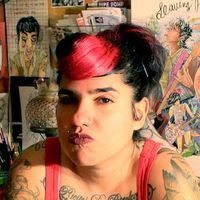
M.L. Rio is an author and former actor who published her third novel, Hot Wax, in 2025. The book follows the story of a photographer named Suzanne in two interweaving timelines—the first as a 41-year-old woman fleeing a stale marriage who finds herself in a traveling polyamorous relationship, the second as a 10-year old girl touring the country with her father, a budding rock star poised on the edge of success. Hot Wax explores themes of family, independence, queerness, violence, and music with a keen eye toward story and characters. Rio spent 18 months living out of her car while working on the book and created a 130-song playlist that follows the arc of the novel. Her previous books are Graveyard Shift and If We Were Villains.
Conversation
On using all five senses
Author M.L. Rio discusses writing on the road, making a deliberately bad version when she's creatively stuck, and rejecting the expectation for women artists to be quiet and subtle.
As told to J. Bennett, 2836 words.
Tags: Writing, Performance, Acting, Inspiration, Process, Family, Failure.
How would you describe your artistic philosophy?
It’s really kind of simple: I always want to tell a good story about interesting people. And starting from that place leads me to much deeper and more significant things. But I have a hard time, just because I think of myself first and foremost as a storyteller. That’s kind of always what I’ve done, whether as an actor or as a writer. I never want to have a Message with a capital M at the expense of the narrative, because I really respect narratives and art form. I think that’s kind of ingrained in our bodies as humans.
I try not to put too much moral restraint on what I’m doing because I think that can hamstring art. I think if you set out to make art with a moral, you can lose the art part of it, because I think art defies those sorts of categories.
Do you typically start with characters or plot?
It really varies. I’m very much an upmarket writer, so I try and straddle that line between commercial plot and pacing, but with a more literary depth of character. Hot Wax is interesting in that it’s quite a slow burn for the first 200 pages, and then everything sort of goes off the rails. But because of that being the way I work, it’s really a little from column A and a little from column B. Sometimes what the story needs will determine character traits. And then sometimes the opposite happens, where who a character is really determines the course of the story. I try to just let that happen organically and lean into whatever feels most important in the moment of the book that I’m in.
When you started Hot Wax, did you have a specific goal in mind beyond good characters and a good story?
Well, the funny thing is I wrote the original version of Hot Wax, which would be totally unrecognizable now, way back in 2016. I think the motives that I started with were probably very different than the motives I had at the time I got to the end of this process, like nine or 10 years later—just because I think the stuff that you’re interested in when you’re 25 is really different than the stuff you’re interested in when you’re like 33. There’s a lot of daylight between those years.
But for me, really it comes from a place of being a performance studies scholar. I really love live performance, whether it’s rock n’ roll, whether it’s Shakespeare, whether it’s insert your form of choice here. And the Hot Wax project was always kind of about exploring how live performance works onstage and the effect that it has on people—emotionally, physically, all of it, because I’m endlessly fascinated by that. I love watching good performers who are reading a room and feeding off the energy of an audience and bringing that into what they’re doing onstage. Because I think that is the purest form of human connection, and communion is just communicating through an art form. And I’ve spent a lot of time in that world. I’ve lived most of my life backstage, in one way or another.
Tell me a little bit about your experience in being backstage and traveling. As someone who’s played in bands and done tours, you really nailed all those little details. As I was reading Hot Wax, I thought, “She’s been in a band, or at least on the road with one.” There are lot of mundane tour details, like gas station stuff and personal space considerations, that you got exactly right.
I love to hear that because the mundane details are really important to me. One thing I see often in fiction—about music especially, but also the theater, which is the other place that I’ve spent a lot of time—is it’s the mundane details that get lost. Fiction has a tendency to romanticize these things, and I really wanted to do the opposite of that, which is part of the reason that Hot Wax is such a gross book in so many ways. It’s sweaty and gritty and grimy and kind of reeking of cigarettes and hairspray and beer. That is sort of the truth of that world that I didn’t see represented on the page in the way that I had experienced it.
But to backtrack to your actual question: I got the bug for dad rock, for lack of a better term, from my own dad, who was not a rock star—which is probably fortunate given what happens in this book. But he grew up in Los Angeles in the ’70s and ’80s, and he was a concert bouncer for a bunch of years because he was a football player, a big guy. I grew up on my dad’s stories of bouncing all these insane shows, like Cal Jam II and stuff like that. I started going to shows kind of obsessively, like multiple nights a week as soon as I was old enough to drive. That bit where Suzanne is coming back from the Fugazi show and gets into the car crash is loosely based on a thing I did: I borrowed, without asking, my mother’s car and drove four states away to a concert when I was 14. I did not crash, but I did get pulled over on the way home and somehow talked my way out of that ticket. Being in the audience for a really killer live rock show was always my favorite place to be.
You mentioned that you were an actor at one point. How does that experience fit into Hot Wax?
I was an actor for almost 15 years, and doing that in a lot of different environments, doing weird site-specific theater. I did work for a theater company that traveled all the time. So I had a lot of experience with picking up the show and taking it on the road. And then I started working for a magazine called The Vinyl District when I was doing my PhD—doing artist interviews, reviews, sometimes being on the road with some of the bands that are personal friends of mine. I was kind of like, “I haven’t really seen this in fiction in a way that feels persuasive.”
It’s still my favorite place to be. I love being in a backstage environment and talking to performers before they hit the stage, just because that energy is so infectious. At the same time, it can be really mundane and kind of a slog in between one town and the next, and [it’s] soul-sucking to go do an event for 10 people after you’ve been in the car for nine hours. This is also how I’ve toured with my books the last two years… That’s also how Hot Wax was finished. In 2023, I decided to really rewrite Hot Wax, top down, and thought that the only way I could do it was living on the road and actually going to all these locations. I sold my house and put almost all my stuff in storage and kind of lived out of my car for 18 months, just driving around and rewriting the book, and it was glorious. I loved that.
Why did you want to write the book while living out of your car?
Well, part of it was just that I genuinely love travel. Being in a state of permanent road trip is a nice flow state for me. Driving is an easy place for me to brainstorm, especially when I’m driving on small state highways where I can really enjoy it. But part of it too is I’ve always wanted to write books that feel like you can climb inside them and live there. I’m a very visceral, physical writer. I like to write with all five senses. If you’re going to get a sense of place right, especially when you’re in so many different places in the same narrative, it’s really important to actually go get boots on the ground and really know what you’re talking about before you try to put it on paper.
My process for rewriting this book was I would go to different research locations and I would spend four hours on the road. I would stop, I would poke around, I would do research, and then I would go to a diner in the middle of nowhere and type for a couple of hours and then get back in the car and do that again in the afternoon. It just felt like the right way to do it. I don’t think I could have written this book just sitting at a desk at home.
You compiled a “master tapes” soundtrack playlist for Hot Wax. Why was that important? Did you make it before, after, or during the writing process?
Oh, it was constant. It went on the whole time I was writing, especially as the book changed and evolved over the six or seven years that I was actively writing it and rewriting it and rethinking it. But for me, music is always point zero of my writing process regardless of what kind of a book I’m writing, if it has anything to do with music or not. I always start from a place of just dumping a bunch of music in a playlist that feels like the kind of vibe of the book because music was my first love, artistically.
Do you write every day?
I do, but I say that with the caveat that I take a very holistic view of what writing is. If you tell yourself you have to write every day, and the only thing that can mean is sitting down with a notebook or a keyboard and putting fresh words on paper, I do think you’re thinking about it wrong. There is so much more to writing than just that part of the process. There is outlining; there is revision; there is marketing, even. And I hate that that’s part of my job, but it’s a big part of my job.
And then there’s this kind of nebulous, what I call the “discovery space” in the really early part of a project, where you might find me just lying on the floor in my living room with my headphones on, with something on the turntable. It might be insane to be like, “I’m working right now,” but I actually am because I need that time to brainstorm and wander around in this sort of imaginative landscape. Research is a huge part of my writing process. I’m very, very research-oriented because I have a PhD in English, so I have a very strong research instinct.
How do you deal with writer’s block?
At this point in my career, I say to myself, “This is your job and you don’t get to just not do it because you don’t feel like it.” If you want to treat it as a career, you have to clock in and do your time. And sometimes it’s just forcing yourself to do the work, even if it sucks and it feels like pulling teeth. I think every job has days like that. That said, I do have my own little hacks that get me out of a rut. My first thing is to get some physical movement. If I get my body moving, the brain will follow, whether it’s taking the dog for a walk or going to the gym. I do a lot of brainstorming at the gym.
When writers get really stuck, they can forget that the most important thing you can do is go engage with other people’s art. You’ve got to feed your creative wellspring if you’re going to produce anything good. If you’re starving yourself of good creative nourishment, it’s going to be really difficult to produce anything good, in the same way that you can’t build muscle if you’re not consuming food. So, that’s another thing I do: I’ll go see a concert, go to a museum, read a book that’s not mine, just to kind of grease the wheels and get stuff moving.
My last ditch thing, if I’m really, really, really fighting my way through it, is I will sit down and deliberately write the worst version of the thing I possibly can. It’s very liberating to be like, “I’m going to write a version of this that deliberately fucking sucks,” because then there are no stakes. And then at least at the end of it, you have something. More often than not, when I do that, after a couple of pages, I will find my way into the flow and I’m like, “Okay, this doesn’t suck as much anymore,” and my good writer instincts will kick in.
When you let go like that, I imagine you can stumble into something usable.
Absolutely. When you turn off your own taste filter, you realize how much of that is actually dictated by cultural forces outside of yourself. After my first book came out, I really struggled for a long time to sell a second book, because the first one didn’t do well. It did have this bizarre second life, like three years after it was published, but for many years editors told me, “We like it, but the sales numbers just aren’t there.” A lot of the feedback we got was that it wasn’t literary enough, that the subject was too lowbrow. There is this attitude in publishing that in order to be sufficiently “literary,” your writing, especially if you’re a woman, has to be kind of subdued and nuanced and very quiet. Having a plot at all is considered kind of lowbrow. So for a long time I was fighting my own instincts of trying to make this book quieter and more subtle and more nuanced. But it’s a book about rock n’ roll. It can’t be quiet and subtle and nuanced. That doesn’t make any sense.
I had this kind of lukewarm version of it that I had toned down in an effort to match the tastes of the industry. Tim O’Connell, who’s my editor at Simon & Schuster, god bless him, said to me at one point, “I like this, but it needs to be bigger. I want this to be their Altamont.” And I went, “Great. Hold my beer.” It was like I just needed someone to give me permission to get off the leash. As soon as Tim was like, “I want this to be bigger and louder and weirder and more obnoxious,” I was like, “I didn’t realize how much I was dying for someone to tell me that, to give me permission to do the weird shit.” As soon as I started doing the weird shit, that’s when it really started to work.
M.L. Rio recommends:
Kittentits by Holly Wilson. The book is exactly as batshit as the title. I loved it so much. I have rarely read a book with such a strong narrative voice. One of the things I really loved about it was it’s also, like Hot Wax, a book about a 10-year-old girl in a lot of environments that she shouldn’t be in. It’s the kind of big, risky, weird fiction that you just don’t run across very often.
Yours Truly, Johnny Dollar. In the past couple of years, I’ve really fallen in love with old radio detective shows from the ’40s and ’50s. It’s just such a charming format that we don’t really have anymore. It’s such an interesting snapshot of a time in American history. My personal favorite is Johnny Dollar. He’s an insurance claims investigator, and so all of his cases are set up as expense reports. It’s so silly, but really fun.
Columbo is one of my comfort watches, and it’s often available on hotel TVs, on Tubi or whatever, for free. There are so many episodes and so many great guest stars. I never get tired of it.
T Bone Burnett. His records have this interesting feeling where they could be soundtracks to movies that don’t exist. As a writer, I kind of love that. There’s one called The True False Identity that’s one of my favorites.
Pretzel shortbread is kind of a niche thing from where I live in South Philadelphia. I’ve never seen it anywhere else, but it’s my new favorite treat in the world. There’s a place in Philly called the Lost Bread Co. that makes a really good one. It’s like a little shortbread biscuit, but it has that sort of dark, savory pretzel skin on the outside. I shouldn’t have used the word “skin” because that sounds really gross, but just trust me that it’s actually delicious.
- Name
- M.L. Rio
- Vocation
- author
Some Things
Pagination