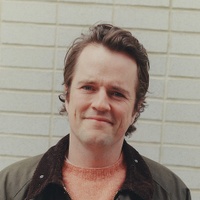
On endurance and the necessity of self- reinvention
Prelude
Born and raised in New York City, Guy Richards Smit is known for his paintings, video installations, musicals and cartoons exploring the themes of narcissism, desire, power, and failure. Using pop cultural forms such as Stand-Up comedy, Pop Music, Comic Books, Gag Cartoons and even television Sitcoms, he has conveyed a sharply observant cultural and political message with philosophical observations and humor. He has exhibited at, among others, The Museum of Modern Art, The Hirshhorn Museum and The Pompidou Center while his gag cartoons have appeared in Hyperallergic, Artnet, and the New Yorker.
Conversation
On endurance and the necessity of self- reinvention
Cartoonist Guy Richards Smit discusses exploring the same ideas through multiple disciplines, getting rejected every week, and remembering to enjoy the process.
As told to Brandon Stosuy, 3818 words.
Tags: Illustration, Art, Music, Film, Process, Success, Failure, Creative anxiety, First attempts.
I’ll start from the beginning.
So I grew up in New York City in Morningside Heights. My grandparents lived on 57th Street, and they had one of these really depressing, dark apartments, and there was nothing for kids in it, except for this 1925 to 1950 New Yorker compendium of cartoons.
So one of my earliest memories were these cartoons. There was this one particular cartoon in there that traumatized me. It was so confusing to me and so alarming and disturbing and funny and beautiful. It’s just beautifully drawn. I found out later, years later, that it was Reginald Marsh.

There’s actually a whole Wikipedia page on this cartoon because it was, at the time, a pretty big deal. It was gifted to the NAACP by him. Reginald Marsh was sort of like the king of the Ashcan school in New York, and also did covers for the New Masses and these kind of radical publications at the time. But at the time, I just remember going like, “Okay, here’s a funny cartoon, funny cartoon. Whoa.” I come across this one. I’d probably seen Roots at the time. So I knew exactly what it was about. And I remember just thinking like, “This is art. This should be on a museum wall and this is what a cartoon can be.”
And I’m eight, so I don’t do anything with that in particular, but I always had a fascination with graphic arts. I end up at the Art Students League. Then I go to LaGuardia High School.

While I’m at LaGuardia, I’m getting into bands. We’re the only non-sort of-performance art people there. I got fascinated by acting. I got fascinated by public persona. When I was 16, I was in charge of this student group called SOS Racism. By that point, I had been in a band, the first time I performed at CBGB’s was when I was 14. So I was part of the whole downtown kids group and had been to openings and knew what was going on. We wanted to make these big banners from the 1986 anti-apartheid rally, so I did what 16-year olds do before you start worrying about shit. I called Keith Haring and I asked if we could come to the studio and if he would help us make banners and he said yes.
How’d you get his number?
I had been involved with this group called City Kids and he had done this big project called City Kids Speak on Liberty where we did this three story liberty statue. So he invited us down and we hung out with him for a good chunk of the day, making these things. There’s photos of it, which still to me blows my mind.

But one thing he kept saying was like, “You know guys, remember, art is for everybody.” He would like say this like a mantra. This was like in 1986. So it was at his height… I mean, I don’t think the guy slept. I don’t know how he had time for this. And as even questionable as I found his art and there were all kinds of jokes about how he was a media whore, I remember him saying that and it always kind of stuck with me. I think I’d always had this kind of interest in art that was outside of a gallery on some level.
I get fine art. I grew up around it. I love it, but I’ve always been a little bit uncomfortable with the divide between it and the rest of the world.
So in the ’90s, I go to grad school, I started in video art. I’d moved to Williamsburg in 92 and I was surrounded by the generation before us that had moved here, and a lot of them were alcoholics and very bitter. I was in my 20s, so I had this judgmental view of them. So I kind of created this character named Jonathan Grossmalerman that was based loosely on this. There was always some reason they couldn’t get a gallery show. They always had these elaborate excuses as to why they weren’t more successful.
This Grossmalerman character did stand-up, where it was on video and it was in a little room where there was no audience response, but there’d be the pause for the audience response. It created this very kind of uncomfortable, manic, confessional, totally toxic thing. I did a show of that in 2000 that got a review from the Times. That kind of kickstarted my career.
A couple of years into that, this whole time I’ve been doing small scale drawings that had a lot of text and it had a lot of humorous aspects. When I look back at them now, I see they’re kind of like preliminary New Yorker cartoons, but at the time I wasn’t thinking that way. I think I was thinking more like, we were all kind of under the spell of Raymond Pettibon and things like that. Nicole Eisenman.
I’d been getting asked to do this Grossmalerman character live, and it was really difficult to do them live because the whole thing was that there was no audience. I didn’t think that worked very well. I wanted to leave that behind. So I started these kind of very baroque, over emotive rock operas. Around 2010, I started to realize I wasn’t doing anything well. The touring was taking too much. I was a new dad, couldn’t really do that.

I took the Grossmalerman character and turned it into a comic book, and I realized that it was essentially kind of like an office comedy, and that it would work as a sitcom, but in a really weird, absurd sitcom. So I contacted Joshua White, who had been working with Mike Smith earlier. When I initially met him, he’d been directing Seinfeld, and the reason I contacted him was because I directed a single camera version of this sitcom that got interest from a production company in England, and they asked me to get someone who knew the business. So I reached out to him, and while this deal eventually fell apart, I had an idea to do it as a performance. So we raised money to build a set and shoot five episodes, one on each Friday night in front of a live studio audience.
And that bankrupted me.
What was it called?
It was called The Grossmalerman Show.
I learned a lot, worked with incredible performers, Neil Medlin, Dynasty, Jibs Cameron, who goes by Dynasty Handbag, and Animatronic from the Scissor Sisters. While I was trying to do the post-production, which was super frustrating because I had no money, I realized if I didn’t develop some other thing that could make me feel like I was accomplishing something, I would go crazy.
I had this memory of going to Prague when I was a student in Amsterdam right after the wall came down, or right after the Velvet Revolution, and there was this bone church called the Sedlec Ossuary. It’s like an ossuary where everything was decorated in bones. Bunting work in bones. The altar was in bones. There were these pyramids of skulls. Every Eastern European death metal band would get their photo in this place. I was looking at this pile of skulls and it’s like they’re these human things, but I couldn’t get any kind of connection with them, which I thought was odd. Shouldn’t we feel some connection with these things?
In order to fake a connection, I decided to give the skulls a business. Like one was a baker. And if he was a baker, he probably knew everyone in the town, and maybe this was his lover, and he owed this person rent or whatever, and it kind of created a little bit of something close to connection.
Later on, I’d remembered that, and I thought I should do 500 skull portraits with just a very simple line of text that described this person. So I worked on that for the next couple of years and created a book.
When I was done with that, which was about 2020, I remembered that cartoon that I’d seen as a kid. I always thought that cartoons were art. I thought to myself, shouldn’t I make these large scale paintings of the perfect gag cartoon?
So I did one, and I was super proud of it, and then I did the next one and it sucked, and I didn’t have any more ideas for what a gag cartoon should be. I realized at that moment that none of this made any sense. First of all, I had to learn how to be a gag cartoonist, and it was really hard. The only way I would really know that I’d become a gag cartoonist is if I submit to The New Yorker, and if they started running my cartoons, then I’d have arrived past a gatekeeper, and then those cartoons—or the good ones—could become paintings, and I’d have done the full circle. I’d have earned the right to do these, and they’d have gone through the whole thing. It just seemed harder and more interesting.
I didn’t want them to come off as like Richard Prince has done gag cartoon paintings. It was really important to me that this had nothing to do with that. I had to invent another persona, so to speak, but as a gag cartoonist.

So I submitted 10 cartoons a week for a year and a half before they bought one. In the meantime, I was coming up with cartoons that were very arty that I knew The New Yorker wouldn’t be interested in. So I approached Hyperallergic, they ran them for a while, and I approached ArtNet. One thing that I love about the whole concept of gag cartoons is the kind of hack aspect of it. I really wanted a gig where I did a cartoon a week and, even worse, like an art cartoon a week. It was super fun and it’s kind of how I really made my name more than The New Yorker.
After a year, I was so exhausted by it because, I mean, trying to find something funny every week was a job. So really only in the last two years have I felt like I was ready to start the project of what it’s now become, which is those large scale paintings.
I started working with Adam Cohen from A Hug from the Art World, and we did a booth at the Independent last year, which did super well. I’ve got a couple shows at the end of this year that I’m working on right now.
Will you only do large-scale if it’s been submitted somewhere?
No, but I have to really love it. There’s certain cartoons where I’m like, I don’t care what anyone says. I love this cartoon, and maybe it has to be a big painting for it to make sense.
The New Yorker has this thing where you submit something by 9:00 AM. They tell you by 10:00 AM if they want to run it for that day, and you have to have it ready by 12:00. So this cartoon didn’t exist before noon, the day it came out. I didn’t really even have an idea. It was like the day after that student had been picked up by ICE at Tufts. Crazily, I did this in like an hour after it posted, a Turkish artist had recreated it in Turkish with Turkish cops and it became like Cartoon of the Week in Turkey, and they take their editorial cartoons really seriously. So it was this crazy day. It started out with nothing and ended up as an international thing.

Then there’s another one, which I can show you, it was actually the most popular, an Epstein files one. Again, it was like when they first started sending the National Guard into DC. Robert Reich ended up sharing it and yeah, it was insane, but MSNBC did a segment on it.

So you were saying before about the divide with gallery art and popular art, I feel like comic cartoons just reach more people. People see it and they share it.
I think my obsession with the single panel cartoon, also known as the gag cartoon, is that it’s the economy of how much you get with a single black and white drawing and one line of text. That you can create some weird thing that connects. It’s essentially the first meme.
I really started with those cartoons and those cartoonists, most of them didn’t actually write their own gags, but they were all incredible artists. I really want to max that aspect out. A good cartoon that doesn’t have the visual captivation of a Morandi is like a wasted opportunity in my mind.
I don’t have the hit rate that I think a number of cartoonists have. It may be because I’m going for something different. I also take way longer to make a cartoon than anyone else I know in that world does. I mean, there’s nothing about cartooning that’s economically feasible. They are essentially paintings to me. Even all these little ones are paintings. I live off of selling them and I don’t think most cartoonists are really able to. Well, first of all, most of them work on iPads, so they don’t have originals, which I constantly argue with them about.

I know that it saves them time. I know that you can literally move a figure closer if it’s too far apart. I mean, you can do incredible things, but in the end, you don’t have the physical proof and therefore you’re selling prints or you redraw it, but that’s work. And I would rather have the fun. To me, I get sensual pleasure from drawing and painting. I’d rather just spend the time on it.
When you’re telling your story of how you came to now, it’s interesting because it wasn’t immediate. I think a lot of younger artists, will just be in their mid-20s and are like, “I haven’t quite made it yet.” And I say, “Yeah, it’s a long path.” It’s a long path, but it makes it more of a stable path, in many ways, when it does take time.
One interesting thing about gag cartoonists is that they don’t die. They live till forever. I think it’s because it’s kind of low stakes. You’re constantly coming up with little ideas and then you sit and you draw it and that’ll get you through the day. And if you have another idea, you’re like, “Oh, I’ll do that.”
After getting one thing printed by The New Yorker, was it easier to get more or is it still a challenge?
It’s still a challenge. They could stop accepting the work at any moment.
Totally. people are often surprised when folks talk about how just because you do publish one book, make one film, it doesn’t mean the next one is going to be easy.
It feels like starting all over again. I mean, some cartoonists are happy to repeat themselves. I’m always looking for like, “Okay, there must be some way for this not to be so hard.” And there are. I have rituals, I do 30 minutes of automatic writing in the morning, but there’s ways of thinking like, “Okay, so that’s funny, but is it the next level of funny?” Most of [that process] is just sitting there and staring and thinking and not checking your phone.
So if you have a concept, do you just keep rewriting the line a million times?
Yeah. In fact, I sent them this line and I sat there and I had half an hour or so before they would respond. And I was still writing it. When they wanted to run it, I was like, “I came up with this better line. What are you thinking?” She’s like, “No, let’s stick with the other one.” And I think she was right.
I used to write for The Village Voice and my editor there, Chuck Eddie, when I was in the music section, his whole thing was about moving things faster. Some of my writing from back then, I dug it back up and I was like, “This is insane writing.” I realized it’s because it’s The Village Voice’s style. They crammed as much as they could into the small amount of space allotted to each piece. I was like, “I sound like I’m on amphetamines.” But it was just like because they’re like—
“Let’s get everything in here.”
And it’s interesting when your stuff shifts with a style. Because some of your cartoons are political, do you get like hate mail or threats or people that mess with you?
It’s happened. Not really. I mean, I really love on Instagram that you can just erase comments and I do that with regularity.
This one, “Hurry Up the Art So I Can Get Back to Whoring,” it made me laugh and I actually was scared of the caption for a while. So I was trying to come up with another one, but that one kept being funny to me. I was like, “Oh, just keep it private.” And then I was like, “Why? I’m posting it.” I actually asked an art critic friend of mine, he was like, “Don’t do it, don’t do it.”

I did it and people thought it was great. It became one of the more popular cartoons of mine. I was actually surprised at how many people gave me the breath to do it.
For you, what is a successful cartoon?
I realized some of my cartoons were a little bit too rough, and I started to make cartoons that I thought The New Yorker would like and it didn’t work. First of all, they didn’t like them and I didn’t enjoy doing them. I also realized that my whole project, I was making cartoons that wouldn’t be of any use to me because they were like me trying to make a New Yorker cartoon.
So I kind of went back to where I was like, “You know what? Well, they’re going to do what they’re going to do. I might as well be enjoying this and having it be useful to my own project,” which helped a lot.

I’ve known poets and they’ll get a poem published in The New Yorker and it’ll happen once, then it just never happens again. It’s interesting. I’m always curious their process.
Oh yeah, I mean, everyone is curious. No one can figure it out. Other than the fact that they’re the last magazine, at least with the cartoons, they go through about a thousand a week, they say. And you can have a real dry spell. I was listening to something about Roald Dahl and how, at a certain point, before he started writing kids books, had hit a wall with his adult literature at a point where The New Yorker hadn’t published anything of his in six years. And you just think like, the other thing is they don’t respond when you send something in and they don’t like it.
You can’t really follow up. I think rejection too is the thing that people have to get used to dealing with as well.
We’ve all dealt with rejection, but the level of rejection with this project is kind of amazing to me. In that respect, it’s made me so much stronger than I was. I’m embarrassed as to how sensitive I was to rejection in the past. Now I can write emails to people who I don’t know and when they don’t respond, I’m like, oh, next one. I always wondered how those people worked and now I’m like, oh—you just get rejected every week for a year and a half.

Some people might assume, “Oh yeah, this person was like an instant overnight success.” I think that’s what people don’t see under the hood of making art. Generally speaking, you are working and then something happens unexpectedly—you can’t really plan for it.
You can’t and you just have to make it as joyful for yourself as possible. I don’t think thankfully I ever bought into the idea that art was going to be easy. There are no doubt some very lucky people, but that’s not the case for most people. And even those lucky people, you can only be so lucky… I mean, to stay on top is a whole other thing.
Guy Richards Smit recommends:
The Metropolitan Museum of Art. I try to go once a week. It’s this incredible resource we have access to as New Yorkers and it’s surefire in terms of seeing high-quality stuff. It’s a bit like church for me. We can get so caught up in the day-to-day that we forget why we’re here doing this stuff and the Met is a great reminder. If you go often enough you won’t feel the pressure to see all of it and you can just focus on a show or two, have a coffee and get back to the studio and work.
A daily practice of automatic writing. Some call it morning pages and it’s an old trick for getting your brain to work creatively. I do thirty minutes in the morning in a ratty composition book that I throw out as soon as it’s full. I transpose any decent ideas to another notebook I keep around. Interesting turns of phrase, new words or weird ones, painting ideas and new themes to explore. I’ve found as I get older, I can’t depend on the random flashes of brilliance that used to occur, but this makes up for that.
Meet new people constantly. Reach out, follow up. It’s the only thing that will get us through this thing.
Watch the films of Peter Watkins. Start with Punishment Park, then maybe Edvard Munch. Study his rigour, lack of fear and bloody-mindedness. Emulate it.
- Name
- Guy Richards Smit
- Vocation
- cartoonist
Some Things
Pagination