On the creative value of transformation
Prelude
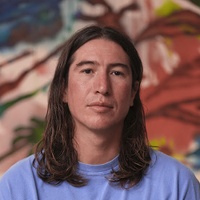
Naomi Falk is a writer, publisher, and chainmaille artisan. She is the founder of Crop Circle Press where she co-produces volumes of art and literature steeped in esotericism and eeriness. She is also a founding member of forthcoming Enigma Editions. Her bookmaking practices are informed by years working for The Museum of Modern Art, powerHouse Books, Archway Editions, and Ki Smith Gallery. Her first book, The Surrender of Man, was published by Inside the Castle in 2025. She lives in Brooklyn and is working on an experimental novel.
Photo credit: Allegra Pagano.
Conversation
On the creative value of transformation
Writer, publisher, and chainmaille artist Naomi Falk discusses tempering chaos with ritual, melding your vision with others, and how nightlife adds to a creative life.
As told to Sophie Golub, 3363 words.
Tags: Publishing, Writing, Jewelry, Mental health, Inspiration, Time management, Collaboration.
I am going to introduce you by identifying some of your primary roles: publisher, editor, book designer, writer, chainmaille artist, event organizer. It’s taken me time to call myself a writer. Sometimes I do, sometimes I don’t, depending on the context. Is self-definition fraught for you? Does it feel contextual?
I have a difficult time defining the end goals of my creative output. My first book came out last year and even thinking about it as a finished “book” feels slightly uncomfortable to me. I express my artistry in several forms, but the work is part of the same malleable identity. It’s hard for me to want to take titles too seriously because I feel like these terms are porous, and assigning too much significance to the capital-A “artist” feels out of tune with what it actually feels like to produce and make art.
Why does it feel fraught to call your first book, The Surrender of Man, a book?
This is for sure project-specific, but it was developed through a lot of channels (BOMB interviews, being out in the world, meeting people in New York, and spending time in creative circles), thus it was patchworked together. There’s an emotional tether throughout, but I could have kept writing it and extending it throughout my life if I really wanted to. To me, it doesn’t have a beginning or an end. I think writing is practice. Publishing is practice. These things are not self-contained in any way. They bleed into so many facets of our lives that it’s hard for me to look at a period of my creative process and compartmentalize it.
As much as I self-market and market for other artists—and try to create coherency—it’s hard to pitch your own work. When I’m working with my authors, I ask them to prepare a two-sentence summary of their projects so that when somebody asks what they’re publishing, they can just use it and it’s succinct. Even though I have perspective from both sides of the publisher and writer fence, I suffer from the anxiety of talking about my own work as much as anyone.
I appreciate hearing you admit complicated feelings around both finishing this work of writing and also letting it exist in the world, since that is the process that you shepherd other writers through.
What is being a “writer” versus being an “author?” People call themselves an author once they have a book out, perhaps by definition, but then what’s really being a writer? Writing is a creative endeavor, but more broadly, writing is also a learned skill, a tool, that many people learn—and that’s taken for granted, too. We don’t all formally learn how to draw or take photographs in the public education system, but reading and writing is part of the curriculum across the board. Ostensibly.
What is it about the book form specifically that has become the vessel for your life work(s)?
Like most writers and publishers, I’ve always been such a reader. And I’ve really always wanted to be a writer. I’ve only ever wanted to work with books in some capacity. Books are timeless. They are transformational to have around, to reference, as much as I grew up as a Wikipedia researcher. They’re accessible on a pretty wide level unlike the way the video game industry (and maybe the film industry) rips art ownership away from us. You and I grew up at the dawn of the web and the democratization of information. Accessibility to information still really moves me. We talk all the time about the advent of the e-book and how we thought that the digital form would overtake the industry and that paper books would no longer have efficacy in the market. That’s not the case at all. E-readers are fun and there are avenues to go down if we could democratize them and move away from Amazon-Kindle.
Visual artists can make a singular work of art which has its entirely own set of magic, but the fact that books are printed in editions, for the most part, means that we’re all looking at the same thing, and that gives me a pure sense of happiness. Even older forms of tech, like cassette tape or VHS, needs to be transformed through something else to be received. We can all have the book in front of us, together; it’s this contained object. Books are ours.
So many books exist in this world because of you.
Both of us. It’s a cool thing. When somebody has a book published, we always talk as if everybody does it. Ben Fama, who I do the Poetry Is Famous reading series with, told me that three percent of books get finished and then three percent of the books that get finished get published. We get to make those books happen. Maybe we increase the odds, even. I don’t know how many hundreds of projects I’ve worked on. You never really know where you might encounter yourself out in the wild when you’re a bookmaker. There’s nothing like it.
Because you work independently, no longer supporting yourself through a nine-to-five job, and wear so many different hats throughout the course of any given day or week, how do you maintain a sense of balance?
Balance is a life’s work in progress because I really like extremes. I like emotional peaks and valleys. I love the opera, theatrics, and dramatics. I can be impulsive. These things all fit well into not achieving balance at all: going out at night or staying home alone for a week at a time, working too much, barely working enough, being lazy, being productive. So I don’t know if I achieve balance, but I think age brings the necessity for it because you just can’t live so deeply in chaos anymore.
I’ve been in the city for twelve years now and in this state for fifteen years, but I’m still excited by living here. Now that I have all of these amazing communities, the concept of “missing out” doesn’t exist. Having time for yourself to work through your to-do list, whether that’s chores or creative stuff or moneymaking work, is easier once you’re settled in and calmed down—or at least once I calmed down. It probably took about a decade for that to happen, to be honest. The things that stimulate me creatively are less social and more solitary.
Balance was not necessarily your aspiration in the past and now is, perhaps forcibly, more of interest. What kinds of routines and rituals do you have for yourself?
I adore the morning time. I have hangups about expressing that sentiment because early morning-riser-supremacy people are genuinely the worst and now it’s all TikTokified and about moving through tasks and fueling productivity.
I like the aloneness and atmosphere of the morning and the way that the light gently filters through the air. It’s calming for me in the way that nighttime is calming for others. Also growing up in Washington State, it reminds me of when I would go to Pike Place early in the morning and the vendors would just be loading into the market.
I love that memory.
A lot of the writers that I like also are morning people; they embody that same sense that my spirit is awake most when the sun is coming up.
I have a morning routine that starts at six a.m., but it’s not intense in terms of productivity. Between the hours of six and nine, everything that I do is just for myself. I pretty much won’t answer emails before nine. I have all of these other tasks that I complete, but they have no order. The only thing that’s routine is TM (Transcendental Meditation) at seven. I jog, sometimes I walk. I like to get in a little sweat. I dream journal and check planetary activities in this calendar my mom got for me. And I make a fresh batch of ginger shots. I have to have a really chill breakfast. I like to cook every morning. I pull from an oracle deck, do something a little bit spiritual. Read. But that all has to happen before nine and then my work day can start.
That is an impressive morning.
I’m sure some might find it obnoxious. But then you’ve achieved what you wanted to achieve in your day before you get into the meat of what has to sustain your life, which is the work and the moneymaking stuff.
You’ve started the day with a sense of control and personal success.
And that comes with the luxury of no longer going into an office every day. I work pretty much every day of the week to some capacity. If I were still going into a nine-to-five, I guess I would need to wake up at five instead because it takes me pretty much an hour to get anywhere in New York.
Do you have a similar routine at the end of the day?
Not so much. Something that’s important in the evening to me is my screen time, looking at images. Doctors can say that it’s bad, but that’s what I like to do. It calms me. I spend a lot of time on Tumblr and Are.na and checking to see what’s been posted in the Weirdcore 2.0 Discord channel (there was some drama in its previous iteration) because a lot of my design work is based in me exposing myself to images and far corners of the internet. I’m also really interested in microaesthetics and you kind of have to be perpetually online to track what’s going on. I spend a lot of time at night scrolling and saving things into different folders, posting moodboards to the apps.
I like to play video games in bed, too. I’m not much of a reader before bed. I light a lot of candles at night. If there’s some significant thing happening with the moon, like a new or full moon, I try to observe that and set goals for myself, not work goals, spiritual goals. The nighttime at home needs to be quiet because when outside there’s always something, a reading and we’re out super late and there’s so much chaos.
You used to work in nightlife and are still active in those spaces. How does that interact with the other elements of your life?
I have been in nightlife-y stuff since I was a teenager working in the music scene. I realized that you really have to be out there in person to meet people. I was so enamored with being around creative folks. It was really exciting to me.
There’s a war in my mind all the time about whether or not some kinds of nightlife are generative. I’m not really sure. I think nightlife can contribute to a lot of bizarre dependencies and nefarious behaviors and patterns, if you don’t have the balance we were talking about earlier, which I don’t. Going out at night is important to me because it is not a productive thing by definition, if you’re not working at the event or for the venue. The idea is that you’re carefree and you feel safe in these spaces. That real element of liberation and freedom is what sustains our focus and our ability to otherwise maintain creative output.
I feel like I’ve been lucky in New York because there are just so many cool scenes with musicians and artists and writers and those IRL connections are central to the work that we do together. I like my internet friends, but the majority of my real ones are people I’ve met at a reading or at the bar or at the club. And it’s such a colorful group.
Even though nightlife is, as you’re saying, a non-productive space, it has ironically been productive for you. Over the years, you have connected with so many people and created niche spaces and communities. Much of that has turned into creative collaborations.
Half of it is just being willing to humor strange conversations with people. I love meeting people that I would never, ever come into contact with in daylight. It’s special to meet someone in New York who you have zero mutual friends with. We’re total strangers to each other. Being loose and not having your computer and your phone in front of you. It’s important to have these shadowy pockets that we inhabit and that we can move through like little rats, you know?
To hone in further on collaboration, why is that so important to you? Do you have a particular approach to choosing collaborators?
In general, the people that I like, that I collaborate with, are people I can be friends with and whose essence I crave. Like water. Or ice. People who move in and out of practicality. I like wacky people who give into their niches and impulses. These artists then become part of my own creative DNA. I don’t really know what drives us to create. I’m always trying to get to the bottom of it, which is why, like you, I love interviewing artists and writing about art. The late Calvin Tompkins has been extremely important to me, the way that he approached writing about art.
I’ve been involved in a lot of different publishing projects and in gallery and museum publishing, but the writers who I think are dancing to their own unique waltzes are ones I’ve published in the past or who I’m going to publish soon: Claire Donato, Lindsey Webb, Mike Corrao, Kelly Krumrie, Lamb, Maggie Von Sacher, Khang Pham, J.M. Cox.
Is there something that you look for in writers specifically?
I don’t look for a good story at all. In fact, story is almost always secondary to me—as much as people always say that a writer should be a good storyteller. I’m not even sure if a story matters at all. As a publisher and editor and reader, I want to get to the core of a feeling, or the psychological transformation that’s fueling the artist’s life at a particular moment.
Is there something that you look for in publisher collaborations specifically? You are currently a founder of two presses, Crop Circle Press and Enigma Editions, and formerly Archway Editions.
People that I can get along with, really. The weirder somebody is, the more I want to get inside their head.
When you’re working with friends, the stakes feel so emotionally high, and I like that, because art is emotional work. I want to feel it all, and know that the work I’m doing is intrinsic to who I am and that it’s aligned with what I want the world to be like. Each publisher brings their own vision of an ideal literary landscape to the table, which is why it’s also so fun to be friends with other publishers.
I used to be adamant about separating work and life, but in creative spaces, it is the way one builds community and opportunities with one another, rather than looking up to gatekeepers.
We are taught that there has to be separation between our work and our personal life, but when you look at institutions, that rule, conveniently, never seems to apply to the people who are at the top. People who are curating exhibitions are friends with those artists. They’re hanging out outside of the context of working on a show together. It’s just the underlings who are told that they need to behave a certain way, that they have to dress a certain way, that they need to abide by this code. It doesn’t make sense to me. Very obviously, this is the force of white supremacy and capitalism and patriarchy, all of those things in orchestration with one another that tells us that being an individual is a problem. It just doesn’t apply across the board. Being able to build the world we envision is the only way for me to sustain my creative life, and to live more generally.
What is inspiring you these days?
There is one thing that always inspires me more than anything else and that’s the Pacific Northwest. I grew up in and outside of Seattle and spent a lot of time around the peninsula and around the Salish Sea. It’s the main reason that I have such a deep interest in esoterica and why Crop Circle Press tries to honor strange and eerie material.
I also am inspired by the gothic imagination as well as the video game interpretation of the medieval. In the past five years or so, I’ve gotten over being a secret gamer because the culture is shifting away from incels and dudes.
My friend Chris Molnar and I have been working on this experimental medieval novel. There are two chainmaillers that are corresponding and, because chainmaille is such an abstract thing to most people in contemporary society, the only way to really paint this correspondence was to learn how to do the thing. And now I make part of my income by being a chainmaille artisan, and I can make the jewelry that I want to wear, which is maybe the most important part of it all.
Okay, Washington State, the gothic imagination, and chainmaille. If you could give yourself a life mission, what would it be? Where does all of this lead?
I want to feel like other people and I are seeing one another and into one another, not just eye to eye. This extends beyond people for me, to the natural world and the environment. I want to know that I am seeing and seen by broader natural forces around us. And back to the idea of balance, a sense of harmony is the most important thing to me, a sense of harmony with the world that can really only exist when one has felt at odds with everything in previous moments of their life.
Naomi Falk recommends:
The most recent feature-length film from the Quay Brothers Sanatorium Under the Sign of the Hourglass (2024): A dusty, layered Matryoshka doll of time and memory based on the 1937 Bruno Schulz novel. Just brimming with their masterful craftsmanship across the board and dappled in grey light. You want to walk into sorrow and never return.
YHWH Nailgun’s brand new album Magazine: They’ve done it again! An elegant tonal shift from their recent 45 Pounds, which came out just over a year ago. The project sprints into a distorted primordial dream; it’s very liberating to listen to an album whose sound is so massive and potent and strangely sensitive that you can make an argument for its references to an endless amount of other music, art, or poetry.
Harper’s Encyclopedia of Mystical & Paranormal Experience by Rosemary Ellen Gulley, with an introduction by Marion Zimmerman Bradley and published by HarperCollins Publishers in 1991: Reference books are some of the most beloved on my shelves. This one is sourced from over 1,100 publications and several hundred periodical articles. Reminds me very much of being a girl in Seattle during the ’90s. Some favorite entries include: psychic archaeology, Fortean phenomena, Kirlian photography, planetary consciousness, and the psychism of plants. Hilariously includes one of the most useless introductions to a book that I’ve ever encountered.
Fatum Betula, developed by Bryce Bucher and published by Baltero Games in 2020: Just finished my second playthrough of this game in which you are questing for the fate of a strange little world. Its design heavily references the dawn of the PlayStation, if that’s your thing. Kind of lonely, definitely atmospheric, undoubtedly magic. Strong writing, too. Certainly a work of art for those with a poet’s soul.
Pierrot: By far the best character of the comedia dell’arte, for, who among us is not a sad clown?
- Name
- Naomi Falk
- Vocation
- writer, publisher, jeweler, artisan
Some Things
Pagination