On creating work that is alive and lives on
Prelude
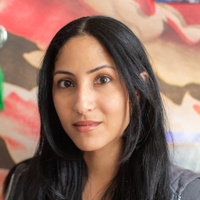
Tamika Abaka-Wood is a London-born, NYC-based cultural anthropologist, researcher and social practice artist whose work sits at the intersection of human behavior, deep time humility and collective futures. Through her independent business, Corner Booth, she co-conspires with many to deliver ethnographic research, insight design, and cultural strategy with leaders across the globe. Tamika’s most alive project, Dial-An-Ancestor, is a hotline and living, breathing, evolving audio archive; a multigenerational and collective work an intimate crew hopes to steward to live for 100 years. At its core, her work is about seeing things as they are, then as they could be at their most potent, soft and liberatory.
Conversation
On creating work that is alive and lives on
Cultural anthropologist and researcher Tamika Abaka-Wood discusses building work that lives beyond its creator, and why creativity should be designed to evolve.
As told to Samantha Becerra-Taylor, 2075 words.
Tags: Research, Art, Process, Creative anxiety, Inspiration, Beginnings, Focus, Multi-tasking.
Has there been a creative piece of work or project recently that has moved you deeply? I’m curious where it has shown up in your body.
It’s such a lovely invitation because, funnily enough, I’ve felt disembodied the last few weeks. There’s a documentary I saw on Criterion Collection from 1975, called Dying, where a filmmaker follows three people and their families as they come to terms with terminal illness. It felt really similar to when I was in Mexico City in January and did a Temazcal ceremony. I felt so ridiculously grounded in my own body, but also connected to other bodies around me that I did and did not know. I felt the same thing watching this documentary about dying. I felt like I was holding two things at the same time: the existential, conceptual nature of what it means to be alive and living, and what it means to be dying.
And I think sometimes, depending on what society you’re in, there’s a tendency to want to overcome or dominate or conquer that feeling. But how can you surrender to the dichotomy of two things happening at the same time? I found myself being like, “Whoa, this body, this vessel that I’m in is the most ancient and future-facing technology that we’ve been given.”
Our physical vessels are obviously very much alive, and I believe a lot of the creative work we put into the world is alive in its own way, too. Do you think every project has a sense of aliveness to it? What makes a project feel alive to you, and do you think projects can die?
I think one of the most evergreen things I can ask people to do, no matter where they’re at, who they are, or what the challenge or opportunity at hand is, is to just ground really quickly in aliveness and death by looking around and counting the things that are alive or dead around you, using all of the senses available to you.
I think this is about paying attention to what is declining and what we want to compost moving forward. What we’re willing to let go of and what we’re trying to nourish and grow. There’s a model from the Berkana Institute—the Two Loops model. It’s about what happens when there’s a system that’s in decline and another one that’s emerging. But I think the more interesting question is: What is the vision, the ambition, or the pure hope of an emergent system? What are we driving towards? Who’s going to be a compost worker who thinks about what we want to take from a dying system? Or what do we need to put in the ground and respectfully lay to rest so not a lot of damage is done for the new vision that we’re trying to create?
Do you feel like the creative space as a whole is more focused on creating new projects versus nurturing ones that are already created?
In 2021, it felt like there was a lot of change in the air, but not really a grounded, long-term view of what we were trying to amend, build, change, or leave behind. In my personal life, I was pregnant for the first time, and my dad was dying. It was the first time I thought, “Oh, my body is a literal coin. It’s the timeline. It’s the one thing that I can reach back and hold the past and touch the future at the same time.” We are literally the link between the past and the future.
That’s so much of where [my project] Dial-An-Ancestor came from. I felt really galvanized by that prospect, but also nervous about the lack of foundational grounding, or a deep-time humility with which I could understand time. So I did a four-and-a-half-month learning marathon with seven other people, meeting twice a week to unravel our relationships to time. There was a loose structure, but we all oscillated between being practitioners and facilitators and participants. I just loved those different roles that you can weave in and out of.
I wanted Dial-An-Ancestor to have the ambition and intention of lasting 100 years because it’s outside of my lifetime. Time is such a material that you can really play with. We’re living in a really high-data, highly quantified time, and I think part of this project is about bringing the qualitative experience of time to the fore. We can talk about the quantitative measures day in and day out, but how does that time feel to you?
What do you believe could emerge when we create projects that have an element of longevity versus something that’s maybe a short collaboration, a short expo, etc.?
I think it is so comforting to think in a longer or deeper or richer timeline. You need to be crystal clear on what your ambition is because, by virtue of lengthening the timeline, it’s an endurance sport. Why are you devoted to the creative project? If all of our answers are based on the current understanding of what it means to be alive, maybe it’s better off as a sprint. And I’m not saying that a marathon is better than a sprint or a sprint is better than a marathon at all.
You have to start thinking about both the timelessness of the creative project and its ambition, but also the timeliness of what it means to be alive today. And when you start answering those questions, you might realize that actually, this would be much better as a six-month sprint. Maybe I’m really interested in this particular moment we’re living in, and I know it has a sell-by date. There can be a real potency in making something for six months because it’s designed specifically for this moment in time.
With Dial-An-Ancestor, it’s not an immortality project, but the ambition is for it to be 100 years. Honestly, Samantha, it only exists as long as the people want it to exist. Just because I say that it exists doesn’t mean that it exists.
Do you believe that some ideas arrive with longer lifespans, or do you think longevity is created by how we, as an audience, nurture them?
I’m really interested in projects that are responsive and can flourish with intention and that are quite instructional. So, I’m obsessed with Felix Gonzalez Torres for so many different reasons. A Portrait of Ross has so many different interpretations, and it can exist in so many different spaces at one time, which means that it is inherently communal; it’s non-hierarchical. The power is not concentrated in one space or one set of people. I am so ridiculously aware of class and race and all of these different intersections and ability. I feel like my commitment and devotion to a lot of my creative projects, it doesn’t just fuel me; it’s about what is fueling other people, also. But I think creativity also requires instruction, rules, boundaries. You can have constraints that are made of concrete, or you can have constraints that are beautiful silks that are transparent or things that you can move and adapt and alchemize. I like boundaries that are malleable and soft and asking for interpretation because I think beautiful things can come from that.
Sometimes I have an idea and immediately want to mind-map it out, thinking about how it might work or where it might go. But I’m curious about how you make space in your practice for not knowing what something will become, and for allowing time to shape it.
There’s a book called Pip Pip by this woman called Jay Griffiths. She considers notions of gender time, what colonialism has done to time, what late-stage capitalism has done to our ideas and our conception of temporality. It’s one of those eye-opening books that you read it, and you’re like, “Oh, shit.” I’m over-indexing in this way of playing with time, and maybe I haven’t even considered that this is something else that I could do.
What would you say to other creatives who may not go forward with a creative project because they’re already thinking about the death of it?
I’ve always been very sensitive to the cyclical nature of life. I am Ghanaian, and there’s this idea of Sankofa. There’s an Adinkra symbol that’s a bird whose face and beak are facing forwards, while its body is facing backwards. The whole concept is that you have to reach back in order to move forwards. That bastardization of the linearity of past, present, and future feels like something that’s been in my bones for a really, really long time. So I feel like I micro-dose death on a daily basis and I would encourage people to create systems and rituals that remind you of your aliveness. On my birthday, every year I’ll go to Greenwood Cemetery. And it sounds morbid, but actually it’s the most life-affirming, exciting thing that I look forward to on my birthday. You just get to be in and amongst multiple spirits, people, ideas, concepts, all in one beautiful place.
My second bit of advice would be to think about what your mission in life is. Mine for the last five years has been to create soft, malleable, potent, irresistible imprints. Not blueprints, but imprints important for other people to fuck with. And that is irrespective of how much money I have in the bank, how many opportunities are coming my way, what land I’m on. It is so context-unspecific. I think having something that is both grounding and uplifting that you can think about holding with you for a lifetime gives me a sense of ease, and it gives me a sense of purpose because you can scale that up and down and sideways no matter where you’re at.
Sometimes I feel like I need everything around me to feel right in order to create my best work or enter a flow state. How do you separate those external circumstances from your ability to create?
Money is part of the material reality of being a creative, but I use the same methodology and principles with C-suite people at huge companies as I do in my own creative practice, which has no monetary or consumer value exchange. Sometimes I look at people with a lot of money and think, “Your problem isn’t money, it’s imagination.” You can throw money, resources, and teams at something, but it’s still going to be mid if you’re existing in a siloed reality. Sometimes you just need to change your context or frame of reference.
I remember during the pandemic, when I was living in Portland, Oregon, everything felt the same. I needed novelty, so I rearranged my bedroom. And even something that small gave me a different perspective. I think changing our frameworks can shift the ways we limit our beliefs, while also helping us realize what’s actually non-negotiable for us.
If you’re someone who has all the money in the world, it doesn’t mean that you’re going to create the thing that actually moves your own needle. I think having some constraints is really helpful sometimes.
I always say, “I said I was going to make this thing. I didn’t say it was going to be good.” For my entire life, I’ve said, “Oh yeah, I’m a dancer.” I didn’t say I was good. “I did some choreography.” Didn’t say I was good. “I cook.” Didn’t say I was good. But I think it’s also deeper than that. We live in such a world where everything is meant to be seen and consumed. What does it mean to create something that isn’t seen, that has no audience, that’s just for you, or your lover, or a parent, or a neighbor? No one needs to see it. What does that look like? I always say, “The smartest, most creative person in the room is the room.” So, how do we create the conditions that the room needs?
- Name
- Tamika Abaka-Wood
- Vocation
- cultural anthropologist, researcher
Some Things
Pagination