On operating within a human scale
Prelude
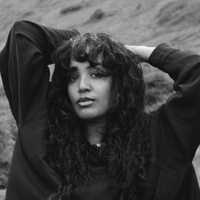
Farah Al Qasimi makes photographs, films and music. Often working with large-scale vinyl imagery and a multiplicity of photographic prints and screens, she is interested in the internet and its hierarchies of information and emotion. Al Qasimi loves the complexity of storytelling and value-building in children’s cartoons, and many of her video works include primary narrators who are anthropomorphized. Through a highly collaborative practice, she has worked with hand-sewn puppets, falcons, African Land Snails, exorcists, and most recently, a Jack Sparrow impersonator. Her work is in the collections of MoMA New York, Tate Modern, Guggenheim New York and Abu Dhabi, and she has participated in residencies at the Skowhegan School of Painting and Sculpture in Maine, Delfina Foundation in London, and the Chinati Foundation in Marfa.
Conversation
On operating within a human scale
Photographer, filmmaker, and musician Farah Al Qasimi discusses the role of the viewer in shaping art’s meaning, the transformative power of co-creating with other artists, and the impact of communicating a very specific story.
As told to Allison Hasiba Abdallah, 2861 words.
Tags: Art, Photography, Sound, Film, Music, Inspiration, Process, Family, Collaboration, Politics.
I think about your work existing in so many different contexts: as public art, in the museum, at the biennial, and in the gallery. How do you approach making work that is meant to live in and respond to many different environments?
It’s changed a lot over the years. I certainly try to take into account what kind of space I’m showing in, and what people’s attention spans may be. But then also there are times where I completely discard it, like in the Sharjah Biennial in 2023 [Um Al Dhabab (Mother of Fog]. Everybody knows the worst thing you can do in a biennial is present a long-form video, but that’s what I did. That project just needed to be a longer film.
I think a real turning point for me was when I had work in the Yokohama Triennale in Japan in 2020. I didn’t get to go [to the exhibition space] physically because of the pandemic. It was the first time that I’d really worked on an exhibition remotely without understanding the space very well, and without having as much control over production as I usually do. But I felt like that opened up a lot of possibilities because it had to be un-precious. I used xerox prints and guided installation via Zoom.

Farah Al Qasimi, PAAD 24, phot by Lance Gerber, courtesy of the artist and The Third Line.
At the Corniche in Abu Dhabi, I remember there were a lot of children engaging with your work.
One thing about the Corniche piece that really shocked and delighted me was [something] one of the security guards that worked on the Corniche told me: kittens had been sleeping in the oysters because they provided both warmth and coolness depending on the time of day. Apparently a kitten gave birth in one of the oysters. There’s a thriving cat community on the Corniche that gets taken care of by so many generous locals. It was great to hear that sculpture was also useful as a shelter.
I love public art so much. It’s my favorite genre of art, personally, for reasons exactly like this.
Yeah, I do, too. One thing that was very funny, and also humbling, is that a lot of the times that I walked by, people weren’t engaged by the sculpture but instead by the sand, which made up the base of the sculpture. There were kids and adults drawing in the sand. I was happy that that also gave people a source of pleasure, it became like graffiti or sidewalk chalk. Every time I walked past, there were new drawings. I know some people also really enjoyed the sonic aspect of it. It’s so funny, the thing about public art—more so than anything institutional, in the gallery world—is that you’re susceptible to public opinion. Somebody made a Google Maps entry for it, and called it “Pearl Corner”—which is not what it’s actually called—and reviewed it and said that it was very calming. If people can review your art on Google, I guess that means it’s truly public.
The sonic component was incredible. It felt mystical and magical. You could almost miss it if you were just hustling by. It kind of required you to sit down and be with the work.
That’s how I approach my photographic installations as well. When I’m thinking about these visual constellations of image and text, I’m also thinking about rewarding the process of close looking and of time spent with the work. And it’s not meant to be a sort of “gotcha,” where if you don’t see it, then you completely miss the punchline. It’s more so that there’s so many different ways to engage with time. A photograph takes a split second to make, but there is so much time that goes into creating or witnessing the conditions in which it is made. There’s years of relationship building, there’s years of research, there’s years of forming what kind of person you are—which will influence what kind of photographer you are, there’s years of just trying to understand exactly what all of it adds up to. I think that for most artists, we’re conditioned to think that what we should show is the product of all of that labor, sanitized in a way that suggests a mastery of a form. I’m more interested in the clumsiness of how you get to make the decisions that you make. How do you get to be the kind of artist [you are], how you have the subjectivity or the viewpoint that you have at any particular moment.

Farah Al Qasimi at PS1-Greater New York, photo by Kris Graves.
I’m curious about the time ratio spent between the buildup and the actual product of a finished install. Do you plan meticulously in advance, or are you largely intuitive once you’re in a space and you’re beginning to assemble the image?
I think it’s different from project to project, but most of the time it’s a world that I’ve spent an obsessive amount of time in, and so it is built from the inside out. Almost always the scaffolding is “real photographs” that I’ve taken out in the world. Whether it’s in Dearborn, Michigan or on the East Coast with my family in New Jersey, or in the Gulf. I think I’m constantly working to tie links between all of these different places—but the links, most of the time, begin with something visual. And then it goes into really trying to break down what aspects of the real world or what aspects of the truth I’m trying to fictionalize.
I’m curious about the origin of your interest in Dearborn. It’s the place in the United States with the largest population of Arab immigrants. It serves as an origin point in so many ways…
I’ve always been interested in Dearborn, ever since learning about it. In 2019, I was invited to do a residency via Wayne State University and the Arab American National Museum, and I lived there for a summer. I think photography is complicated because, in any scenario you’re occupying this position of an outsider or a witness, even if you’re also a participant. That tension is always there.

Farah Al Qasimi, Melon, Dearborn, courtesy of the artist and The Third Line.
Dearborn was so incredible to me because it felt like Arab identity was not monolithic in the way that it is in the rest of America—there are Levantine Arabs and Gulf Arabs, Shias, Sunnis, Chaldeans, Christians, agnostic Arabs, recent immigrants, fourth generation Arab-Americans… My first weekend there coincided with July 4th. I was walking around a residential area with the filmmaker Razi Jafri, and people were setting off fireworks in the street. Everybody was sitting outside on lawn chairs, smoking hookah, talking to the neighbors, and grilling… At one point a cop car pulled up and I thought, “Oh no, we’re all going to get in trouble.” The officers got out and they’re all Arab. It was fine. They laughed it off and gave a polite warning, and then drove off and everyone cheered. There was something in that exchange that was really complex to me, because it felt at once deeply Arab and also deeply American. It felt so steeped in Midwestern tradition, that kind of neighborly hospitality.
Also the transforming of basements and garages into hangout spots, which is not really an East Coast thing, culturally. When they left Lebanon, my mom’s family immigrated to the East Coast, and there were pockets of communities from their region that were tight-knit but quite small. It didn’t snowball the way that things did in Michigan because of the proliferation of industry and factory jobs. There are also so many incredible artists, thinkers, poets who are first-generation who are breaking all kinds of molds. I think there’s a lot of really complex thinking happening there. There’s a lot of intergenerational dialogue and it’s pretty amazing.
The idea of garages being transformed into social spaces makes me think about the interiors in your work. You often capture moments that feel very vulnerable or personal. What is your relationship to the subjects in the photographs and how do you approach these moments of intimacy?
Some are my friends. Some are strangers who I met and asked to photograph. Some are people I’ve known for years. Some are people I’ve known for months. I think the concept of intimacy has always felt very taboo for me—the kind of closeness that allows you to exist in somebody’s bedroom. Being a teenager and going to your friends’ houses, you’re going to lie on the bed kicking your legs in the air, leafing through magazines or playing CDs. I mean, not this generation of teens, but my generation… But at a certain point you stop hanging out in each other’s bedrooms.

Farah Al Qasimi, Climbing Prop Warehouse Facade, 2018, courtesy of the artist and The Third Line.
Growing up in the Gulf, there was a real protectiveness around the sanctity and privacy of home life. In the Emirates, there’s a nationwide rule that houses must have walls around them. So unless you live in an apartment building, you can’t have an open lawn that faces the road. You don’t see kids playing in yards… I mean there’s kids playing in the street. But there is a very clear facade separating public life and private family life. When I started making photographs of my friends in my 20s, it felt transgressive to be going into people’s bedrooms and to be spending time together in these spaces that are meant to stay guarded and sacred.
One of my favorite photographs is of my dear friend Gaith, who is just sitting in his brother’s bedroom. It’s very sanitized and white. There are no real signs of decor, except for the shadow of a rose in a Perrier bottle. I remember that summer, Ghaith had just started his mandatory military service, and he had lost all this weight. He was sharpened and tough-looking in a way I wasn’t used to. We took this photograph and he’s kind of off-guard. At the time, there weren’t a lot of photographs of young men like that, and I was interested in contributing to a canon that existed outside of the official portrait, or the home photographer and the family album.
I’m thinking about the role of sound and music in your practice. How do you think about sound as being layered into your work visually, and in terms of creating an environment, a mood, or an experience?
The first real use of sound in my work was when I started performing in graduate school. I had been playing in a punk band for a few years and I moved to New Haven and we couldn’t play as much anymore. I started writing these musical performances that were combining original music and choreography and scenography. I was really sick of the challenge of making photographs in a place that I was unfamiliar with. It takes me a while to really understand the complexities of the environment that I’m in, enough to feel like I could possibly get out a camera. So I had a moment where I was like, “Let’s actually forget about the camera.” I started doing all of these other things that engaged more with songwriting as a storytelling tool—the song as a container for a performance or a video. The more I did both, the more I started to think about the structural connections between the visual worlds I was building. Thinking about rhythm and timing, and eventually starting to use rhythm as an editing tool. These are things that would be completely intuitive to somebody who was a trained filmmaker or editor, but to me, they were kind of revelatory.
And then suddenly, I started to slowly pull those two worlds closer together. With the oyster piece [in the Public Art Biennial Abu Dhabi], that was the first moment that I thought, “I’m not making a song. I am not making something that builds or crescendos, that has a point A or a point B or a point C.” Instead, it’s something that is more spatial. The sound itself is material. You could move in between the pearls or the voices and you would have a completely different experience depending on where your body was moving. I think about sound a lot more as the pulse of the thing that I’m building.

Farah Al Qasimi, Tweety Bird Hoodie, courtesy of the artist and The Third Line.
I just had the opportunity to work with Joe Namy, who’s an incredible musician and an artist and is also from Michigan. He worked on sound design for a film that I just finished [Time of Misfortune, 2026], and that completely brought a whole new texture… How do I put it? How do I describe what he did? Because it is actually very complex in the way that it sucks you in. He saw all of the sound in the film as material rather than something illustrative or ornamental. It was exciting for me, and it influenced a lot of the visual editing, too.
Is that your first time collaborating with someone on the sound for your work?
I’ve worked with great engineers in the past, but this was my first time collaborating on sound design.
I’m curious how that feels. You have so much experience with sound. How was it working with another artist to implement that element within your own work?
It felt really good because Joe is generous and is a great listener. In a lot of the decisions he made, there was an intrinsic understanding of what aspects of that sonic universe needed to be processed or played with a little bit more, what could become repeated motifs. There were also a lot of surprises.
For me, the hardest part of working with other people is realizing the gaps in my own communication, in trying to assign language to the amorphous thing you’re envisioning in your head.

Farah Al Qasimi, screen grab from The Curse, National Pavilion - UAE, 2026, courtesy of the artist and The Third Line.
You engage with themes like racial stereotyping, Islamophobia, surveillance, your personal family histories of resistance, the impact of global warming on coastal communities in the Emirates, and the ongoing genocides throughout the world. I find that through this specificity, your work becomes universal.
Everything I’ve seen that’s really influenced me has been almost microcosmic in scale. For example, I read about World War II in history books. I took AP History. But watching the 1988 movie Grave of the Fireflies, an anime about a young Japanese boy who loses his sister to an American bomb—that did something to me that no history book ever could.
We’re existing in a timeline where we have unmitigated access to everything that’s happening in the world at any given moment, and our processing abilities have not caught up. But I also think humanity is the counter to futility, thinking about the individual and not reducing people to numbers.
Another example that isn’t based in reality but evokes empathy through cartoons in a different way….is Shark’s Tale, have you seen it?
Yes…
My friend Elle Pérez, years ago, we were talking about my decision to be a vegetarian. I’ve been a vegetarian for 14 years. And Elle said, “Oh, it’s like that scene of the shrimp from A Shark’s Tale.” There’s a scene where a shrimp is about to get eaten by a shark and pleads for its life, saying, “Please don’t eat me. My sister got a job at the factory and just had a son…” and goes on to talk about all the people that depend on him in his life and need him to live. And there’s something about that cartoon shrimp that just moves me to tears. And every time I see a shrimp cocktail, I think about that scene. This isn’t to push a vegetarian agenda, but it’s to say that I think it’s worth going small when the impulse is to go really big and try to tackle every problem and try to highlight every injustice. I think our scale is human. Or maybe it’s shrimp-sized. That’s the scale that I try to operate within.
Farah Al Qasimi recommends:
Watermelon Ginger slush from any Hawa Smoothie location
O Sacrum Convivium by Olivier Messiaen
Sherihan’s Fawazeer Ramadan
Snorkeling

Farah Al Qasimi, Security Camera, courtesy of the artist and The Third Line.
- Name
- Farah Al Qasimi
- Vocation
- photographer, filmmaker, musician
Some Things
Pagination