On the possibilities of form
Prelude
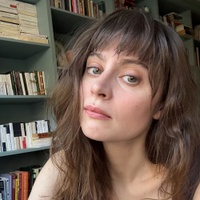
Emma Ruth Rundle is an internationally recognized musician and a multi-disciplinary artist: a painter, director, and poet. She has released 6 full-length solo albums and collaborated with other artists such as Chelsea Wolfe, Thou, and others. Her music has been described as a hybrid of folk, ambient noise, and metal; as well as “patiently haunting” (New York Times), “swelling with gothic drama” (Pitchfork), and “starkly beautiful” (The Guardian). She was the first female curator of the Roadburn Festival in the Netherlands and has performed extensively all over the western world. She has had two solo exhibitions of her artwork (On Dark Horses at Ars Memoria, Chicago 2018; Dowsing Voice at Lethal Amounts, Los Angeles 2022) and has published poetry in The Heartworm Reader and in Sad Happens, an anthology by Brandon Stosuy. Her debut poetry collection The Bella Vista (Unnamed Press) is out now, as is her most recent album, These Killing Times.
Conversation
On the possibilities of form
Musician, visual artist, and poet Emma Ruth Rundle discusses working with doubt, the importance of vulnerability, and why she finds strength in community
As told to Dianca London Potts, 3536 words.
Tags: Music, Art, Poetry, Process, Focus, Multi-tasking, Inspiration.
The Bella Vista begins with a Nietzsche quote: “That which is done out of love is always beyond good and evil.” Love is also evoked in your titular poem. What role does love play in your creative practice?
That was an intentional thing with the publishing date. Every year, for many years I’ve made little hand-painted valentines and sent them to friends and sold a few… that’s a tradition of mine and I wanted to have the book as my Valentine’s Day offering. And it does deal a lot with romantic love. That’s a major theme of the collection… the tenuous nature of two human beings coming together. There was so much that I was feeling and couldn’t say.
I think art in general for me, there’s so much I don’t understand—experiences, conversations, years, bigger spiritual ideas, connection. It’ not always easy to break it into a direct question or a conversation. Music and writing and painting and all the arts are a great way to try to reframe or try to understand, to put the fragments into a frame and scramble them into something that makes sense.
I think that writing this was my attempt to organize that inner chaos and the pain that comes with love.
That makes me think of Margaret Atwood’s book on writing, Negotiating with the Dead. In it, she talks about the way writing is an act of devotion, how it’s something that’s done in the dark then brought into the light. It’s like a labyrinth you move through to share with others.
And the love, you need to somehow tap into that. I think there’s a novelty and a newness sometimes when any of that could even last years when we start working on a project.
The main reason why I make art is that some part of my consciousness disappears into the thing, whether it’s in the researching or the making or the details or the imagining. You suspend a type of reality, and that feels very much like love because it consumes you. And then when that novel experience fades, to continue doing the thing, the little mundane details, that’s the dedication and the love… But the duty of it, we carry that through and that’s a type of love, I think.
Throughout the collection, there are these moments that repeat throughout, I think there’s six of them. It’s the Italian word for kiss?
Yeah, baci.
Yes! It made me think back to Engine of Hell and the role can be imagistic, but also subtextual, structural. Did The Bella Vista help you discover anything new about the way structure or thematic cycles have guided you?
I don’t know if you’ve ever had one, but baci, it means kisses. They’re also these little hazelnut chocolate truffles that are wrapped. They come from Perugia in Italy… they’re very delicious. When you open them, they come with a little quote. I call it a fortune. They tend to be romantic or metaphysical, and I love that as a format.
Structure and format can be really helpful scaffolding to arrange ideas on. When you’re putting something together like an album or a book, having those types of repetitions, I think helps give a completeness to something… And then some people take it further. Like this one book I love by Victoria Chang, Obit. For the people who haven’t read it or who will be reading this interview, it’s a book of poetry written in obituaries.
Going into a project with a very strong form can be useful and it’s nice to think about those things as either what you’re going in to do or something you can use from a toolbox that helps organize your idea or create continuity.
What role does embodiment or bodiliness play in your relationship to form or voice? When you’re starting a new project or revisiting a work-in-progress, what does that look or feel like?
Interesting… I’ve been thinking about this … I’m just going to talk in mind with your question. I was just playing guitar before we talked and I’m working on some new music. What I’ve noticed recently is that one of my attractions to the arts is this almost sublimation, this vanishing that happens where you just are away. I think that in my life as a person and inevitably then in my work, I’ve really struggled with being in a body and wanting to escape it. I’ve never been a very graceful or coordinated person.
A few years ago, I started taking ballet lessons. I wanted to try to do something that I would be terrible at, but which I thought could help me become more physically grounded and help inform my other practices. When you’re on the lifetime scavenger hunt for creativity, anything you do that can push you, can help enrich the things that you are better at, like my guitar playing or music. Music and dance have such a connectedness.
I’ve been noticing lately that my eyes are just unfocused, that I zone out a lot. And it’s a little worrisome… I need to start being more conscious of my body, because I spent a lifetime trying to get out of it. I want to get high on the arts, I want to go off into images and sounds, to transcend feelings, physical feeling.
It’s always connected. You can’t have the experience without the body. I tend to be a depressive person, and I think if I was left to my own devices and didn’t have a really intense, mean voice in my mind telling me, “you must do this thing…” that I would probably just lay down all day and zone out. Singing is very physical and it’s something that puts me in my body. I’ve been taking opera lessons [like] with dancing, I want to learn a new way to use my body. I feel [it’s like] constantly having to play little games and trick myself into doing things that are good for me.
I have to force myself to do these things because I am perpetually living in fear. I am terrified of the world. I am terrified of everything that happens, so it’s like, “Come into present time in that moment. Say hello. Is the wind blowing? Are the neighbors there? How does the light look on the grass, what does it smell like? How do I feel my fingers and toes?” Having to do that throughout the day at intervals, to put myself in my body because I want so desperately, on some deep level, to escape from my body—those things ultimately are good for our process, our brains, we need to take care of ourselves in that way.
I’ve been lucky enough to see you perform and I feel like I’m more in my body at your shows. You bring such intention into the moment by encouraging people to be present. It’s lasting.
I love that… Performance is its own thing we can have a whole conversation about. I read this book called A General Theory of Love. They talk a lot about limbic resonance and the emotional brain. The book is dense, but it’s very interesting… There’s something that is a nonverbal attunement that happens between people at a concert.
I also think being at a concert, as a performer or as an audience member, is such an important thing. It’s still such a punk rock thing to do, to show up in person with other people and take a journey… something that you’re engaged in, and you go through the experience in a group of people, it does something to our brains that I think is extremely important. I find myself feeling balanced also after having that experience.
As I’ve gotten older, I’ve started to think about myself when I go on the road, which I have a difficult time with because I’m very introverted, especially when I got sober… One way I alleviate those anxieties is to think about how it’s a thousands of years old tradition. Bardic people, going around and singing. It’s not about me; I’m just carrying on this tradition. I also think about how I feel when I’m at a concert.
People talk so much about processing their feelings, and it’s like sometimes I cannot cry. I cannot feel my feelings and when I go into a room of people and listen to somebody playing music, suddenly I’m in tears. I am feeling the feelings. And they’re coming through my body. That is so valuable to me… I think that the ingredient of the audience is so important, to be one among many… so when I perform, I think about that experience and that if I’m doing anything that could help facilitate that for someone else, then that makes what I’m doing worthwhile.
When I was reading your collection, I kept thinking about “I Read Too Much Hemingway,” which appeared in Heartworm Press awhile back, and “Too Much Hemingway,” which appears a bit later in The Bella Vista. Those two poems felt like two sides of a doorway.
I was wondering what revisiting works that were shared in or crafted for different spaces or audiences has taught you about your process? What does it give you permission to lean into?
First of all, I will say one thing about poetry, which is different from music, is that it is a slow art on a whole new level. I’m a slow-moving artist anyway, but when it comes to a project like this or like an album, it’s slow moving.
When that poem was originally published, that version, I was already starting to write the book. It was an opportunity for me to have some work published… Even though I knew it was part of a larger work or that it could potentially be part of this thing that I realized I was writing a book.
One thing I like about poetry and about the format of publishing individual pieces is there’s all this freedom to rework and re-edit and develop them until this moment when it’s published in a book. I will not rework these poems and then continue to publish them. This is done. But until that moment happens, I think that it seems that it’s completely appropriate to revise, re-edit, rethink it within the context of the whole of the book.
With Engine of Hell, I was pulling back instrumentation and more focused on lyrics and language. With poetry, it’s even less. There’s no music to tell you any subtext or direct your emotions. You’re there with the new form of the words on the page. There’s a lot of editing and cutting and some of it is, “This phrase doesn’t work, this language, I simply don’t like the way it looks here.” There was a lot of surgery going on. And you can have little generative side pieces coming from some of the off cuts. “Okay, this little piece that I amputated still speaks to the piece and it works on its own so I’m going to create another little version of that and put it later… “The exquisite corpse approach…
I did a tour where I was doing a lot of songs from Some Heavy Ocean, which I wrote over 10 years ago. At first there was a lot of internal resistance to this idea. I did not want to revisit it. But I found that there was something to be learned and gained from taking old music and lyrics and bringing them into the present with everything I’ve learned since then sonically. I decided to play this music on a classical guitar with amplifiers and pedals, so re-imagining it now… as the musician I am now and bringing my experience and knowledge and what I’m interested in now to the old work gave it new life. It ended up working in a way that I didn’t anticipate.
When I think about going and taking something that was complete and then just doing it exactly as it was written in this rote way, that is very devoid of creativity… I think it’s so crucial that if we are going to revisit work, that there’s room for it to be alive in the moment.
I wonder how that will go forward for me with the poetry, because like I said, I don’t think that it would be appropriate to edit any of these any further. I like to take license when I’m reading something or performing a song… I will change the structure or embellish in some way because we need to live in the moment, the present moment in any performance is such a potent ingredient. The energy of the room will inform how you’ll deliver something, so I think about that.
Can you share a bit about the companion vinyl to your collection and the way it spatially and temporally collapses distance through sound? What did navigating that part of The Bella Vista affirm for you?
Yes! I love that. I love possibilities. I think one reason I’m drawn to music and poetry is that there’s an elusive nature to them and that the meaning isn’t explicit. Part of my practice is that I’m a big collector of sounds. It’s kind of like I was saying with the mindfulness walks, there are interesting things happening in our environment, and when we actively decide to tune into them, it’s exciting.
I collect textures and collect music I hear. That particular folk song that was playing at the beginning and end of my [2024 tour is from when] I was traveling. I was in Zagreb and I was staying across from an Irish pub and there was some kind of reunion of a family. There were 30 people outside and they were singing that song together, taking turns singing verses. That chorus where everyone joins in, it stopped me in my tracks and I just listened… and then I recorded it.
I like to bring things in from the world. I also like the artifacts that come along with the clunkiness of the recording technology, that you can hear the phone microphone wind, things in the pockets, the phone hitting, or the microphone hitting a table. I think it anchors the listener in a space.
A lot of well-produced music happens in this vacuum where we’re not really super aware of the physicality of the space, and it removes us from the humanness and the blood and dirt of living. What I’m trying to say is there’s a perfection that can arrive from this very high-end production where you contain these ideas and this super ideal way that cuts ties with the messiness of how things actually are. And I’m attracted to that. I’m attracted to the messiness and the clunkiness… I love to hear recordings of a person in a space. I like to hear the space too, because it’s like a little extra view. The window is suddenly a little wider and we see a little more of the context.
I love Nils Frahm, he’s probably my favorite living artist. There’s some of his recordings where you can just hear the action of the piano. We’re not just hearing the perfect notes. We’re hearing the things moving. It connects me to the human being making that music.
How did this moment in your creative practice and your career nourish you as a person? How do you hope this work might nourish your audience?
I’ll just be super honest… when I was writing this, I was not writing music at the time because I was traveling so much. I was performing Engine of Hell, extensively, and writing these poems became my purpose for living. It was the thing I was obsessed with and focused on.
Looking back on that time, I don’t know that I’d want to wish that on anyone, but I also long for that intense drive and desperation that can come when you’re just holding onto something in this way.
I needed this. I really needed this. I needed it in so many ways. When I was making it, it gave me a place to be. I think there’s sometimes a dark side to creativity. I think a lot of my work has subject matter that can be a little bit unsavory and that at times, I think about it as an ethical question… is this something that’s going to help or harm others? And I have to come back to what I mentioned earlier about being at a concert and how it affects me and it helps me find a place for my feelings and my experiences so that I can let them come through.
When I read other people’s work, it’s also like what we were talking about with the island. In reading someone else’s work, for instance Something Bright, Then Holes by Maggie Nelson, suddenly, and I know it seems cliche, but it’s how we know that we’re not alone… That in and of itself has tremendous value. I think that just continuing to document our experiences as human beings has an intrinsic value. I have to believe that to carry on with what I’m doing.
I’m plagued by doubts constantly. The last thing I want to do is hurt someone else or contribute something harmful to the world … I’ve been thinking so much lately… What is our role? What are we supposed to be doing right now? I don’t want to leave a wound anywhere on anyone else, that is not my intention. And I do think that that’s different than coming out and saying something that could be a little bit uncomfortable to hear… When people are vulnerable and share that in their work, and I happen upon that work, it helps me. It helps to feel like I belong, like I have a place.
It’s a way of affirming what it is to be a person.
Yeah, there is a time and a place for it, I believe…It’s a little world that you can go into and lord knows, I like to have worlds that I can go into. And I’m so grateful to all the other artists in the world who keep making those worlds, because sometimes we want to get out of this one or find a new way to think about this one.
I feel like you intuited my last question. How has creativity become a form of survival? Has it helped you find courage or hope along the way?
I’ll just describe a few days during which I was paralyzed by fear. The greatest gift of choosing the life of an artist is walking alongside the other people who do that. You end up with these lifelong friendships with people—everyone that’s involved in our worlds of music, of art, of film, of dance, people, concert promoters—this whole world that is a legit community of people. We can call each other and have camaraderie and friendship. That. To realize that I’m not alone is so valuable. Like we were saying earlier, I think, particularly with performance, there is just such a potent example of gathering, that is so important and powerful.
I don’t think that what I wrote in my book is the most important piece if we’re talking about how to deal with existential dread. I think it’s the purpose that we find in doing something. And that can be varied. That can mean so many things.
People on Earth struggle so much with the intensity of the inner dialogue, and it’s like, “okay, whatever you need to do to just keep going.” That’s why when I was taken back to the other things we talked about, I think sidestepping some of those little thought games, thought patterns by doing something completely weird. Like suddenly, I’m going to sing opera. I have no plans to ever become an opera singer, but I’m tricking myself into singing and doing something that I’m engaged in… I’m learning something new. I’m practicing it with voice and being in my body. I’m mindful about that. Creativity is about this doing, this dance with all those forces that are in the way.
Emma Ruth Rundle recommends:
Martyr! by Kaveh Akbar
The David Sedaris Masterclass on Writing and Humor
Novelist as a Vocation by Haruki Murakami (This was absolutely wonderful—and any creative person can benefit from reading it. I read it straight through! I think you would like it too!)
Trip to Echo Spring by Oliva Laing
Bluets by Maggie Nelson
- Name
- Emma Ruth Rundle
- Vocation
- Musician
Some Things
Pagination