On confronting your soul in your creative work
Prelude
Brittany Markert is a photographer and filmmaker based in New Orleans. For more than a decade, she has been creating In Rooms, an evolving visual narrative formed by analog self-portraiture, staged conceptual photography, writing, artist books, and 16mm filmmaking. Markert uses interiors as a psychological space, constructing images that explore identity, memory, grief, transformation, and the unconscious. Mirrors, masks, archetypal characters, and sacred objects recur throughout the work, forming a visual language that shifts in meaning as the project—and the artist herself—changes over time. Her practice is informed by surrealism, the writings of Carl Jung, ritual, and the work of women artists and writers who have used self-representation to examine interior life. Her photographs have been exhibited internationally, including at the Brandts Museum and the Ogden Museum of Southern Art.
Conversation
On confronting your soul in your creative work
Photographer Brittany Markert discusses putting herself out there as a solitary creature, feeling light when everyone else describes her work as dark, and why artists need each other.
As told to Erin Evans, 2277 words.
Tags: Photography, Film, Beginnings, Inspiration, Process, Failure, Identity, Collaboration.
When did you move to New Orleans? How has that impacted your work?
I moved to New Orleans in 2016, but I first visited in December of 2014. I had just created a piece in New York, which started the whole series called Behind Closed Doors, which to me is about curiosity in life and having so many paths to choose from. Two days later, I got invited to New Orleans. It forever changed my life. I believe in synchronicities and connection, and I do feel like I was supposed to be here.
My experience in New York was cutthroat, ambitious, energetic. It’s like putting yourself in a blender. In New Orleans, it’s slow. People don’t care what you do or how you dress. There are no parties to go to. No hierarchy. I mean, there are hierarchies everywhere, but it’s different. New York is a place you go to learn, and it can satiate your ego. New Orleans is a place to strip yourself of the survival skills of New York and confront your soul, which can be humbling. I wanted to confront something deeper that didn’t necessarily work well in the social networks of New York. New Orleans gave me a place to learn how to be self-sufficient. It was the first time my external environment mirrored my work. It was like I already knew the city.
I know your series In Rooms is focused on its subjects’ inner worlds. I’m wondering first where that title came from.
I came up with the name three or four years before I’d ever picked up a camera. I had been modeling while I was in college. When I moved to New York, I was mostly working with artists doing nude or conceptual work, and when I was in California, often these photographers rented hotel rooms or [would shoot] in these temporary spaces. That is where I originally confronted this tangible pulse of energy between people. You go into this space—with a camera, specifically—and it was like this whole world existed that disappeared when you left. This creative, energetic world that was unique and beautiful.
I was on a plane, and the name In Rooms came to me. I originally thought I would make a book of my modeling work. But one of the delicate parts of photography is that, ultimately, the rights belong to whoever has the camera. When I was modeling, I started producing and getting involved, but I also knew I didn’t completely have the rights to create my own book. So I was like, “Why don’t I just try to take pictures?” I started doing that as a way to have my own authority.

Brittany Markert, As Below, 2017, silver gelatin print.
Your first photos were of yourself, right?
Myself, other models I knew, people I was dating. I’m pretty solitary. I come from a mathematics background, and I didn’t have communication skills, emotionally and socially. I was nerdy and awkward. This project has educated me on how to name things. In the beginning, I didn’t know how to tell people what was in my mind. I didn’t go to art school, so it all seemed foreign. My examples were these men that had photographed me in hotel rooms, and thinking about how you make movies, which I did not really know.
Has taking pictures helped you communicate with other people?
Yeah. It was surprising to be such a solitary creature, and suddenly I’m putting out self-portraits and imagery, and all this attention is flooded toward me. People are wanting to work with me or be involved with the work. It felt flattering. It opened a lot of doorways—you could say a lot of rooms for me. It was overwhelming. Without understanding my own voice, it led me in a lot of different directions.
I read that you’re interested in darker emotions like fear and madness. What draws you to those themes?
It is interesting you use the word “dark,” because something I thought about recently is that I feel light. I get associated with darkness and the word “dark.” I never thought of it as dark. One of my gifts is seeing the unseen and naming it, and that brings a lot of discomfort. I see how much discomfort adults have with emotions and things they can’t name. It’s discomfort; it’s not dangerous. I think for many women, throughout generations, my work is naming and giving expression to things that everyone has felt, but that maybe they were silenced from saying… Society would like to shift blame to people who see things honestly.
I’ll tell people when we shoot, “I don’t know why, but whatever I photograph turns into something else.” It just clicks. It aligns with me. What is this image revealing to me about something beyond my understanding?

Brittany Markert, Secrets, featuring Brittany Ball, 2024, silver gelatin print.
Another photographer I interviewed, Polina Ganz, said something similar: that people would describe her work as dark, but she hadn’t thought of it that way and was surprised by that.
I don’t think about her work that way either. I do understand why people say my work is dark. What’s interesting is there’s been this resurgence of horror as art in recent cinema, like Obsession, Backrooms, Teenage Sex and Death at Camp Miasma, and Weapons. Psychological horror is a way to explore things that you can’t say.
Considering how you came up with the idea for In Rooms, it makes sense that the characters, or subjects, are often confined. There’s one subject who is plastic-wrapped. Regarding your idea of an inner world, is that supposed to be in contrast to the confined spaces that the subjects are in, physically?
I think In Rooms is a political statement on being a woman. I use rooms, which in theory are confined, because I have access to them. You can’t really do my work outside in a spacious environment. So it’s ended up having a confined feeling, which was never something I intended, but it connects to us all having our own thoughts and how they can impact us.
I’ve done a lot of research with the writings of Carl Jung. I’ll already be doing something, then I read something of his, and it mirrors back something I’ve never put words to—which is, for me, the beauty of art. We’re all mirroring experiences to somehow move energy and advance society. I’ve created these characters over the years, and in different spaces, I pull out different ones. Carl Jung has this idea of the psyche being an archetypal universe. When I read about that, it started to make sense that I was exploring different parts of the psyche. Now I have more awareness of what each of my characters are.
I recently did the Saran Wrap picture, which feels political, but also humorous. I didn’t plan that picture in the morning. I just thought to go get Saran Wrap at the grocery store. In that picture, [the subject] is holding it herself. I’m humored by that image. She’s laughing, and she’s wrapped herself up; despite all odds, she’s found joy in this structure. She’s made the best for herself in the circumstances.
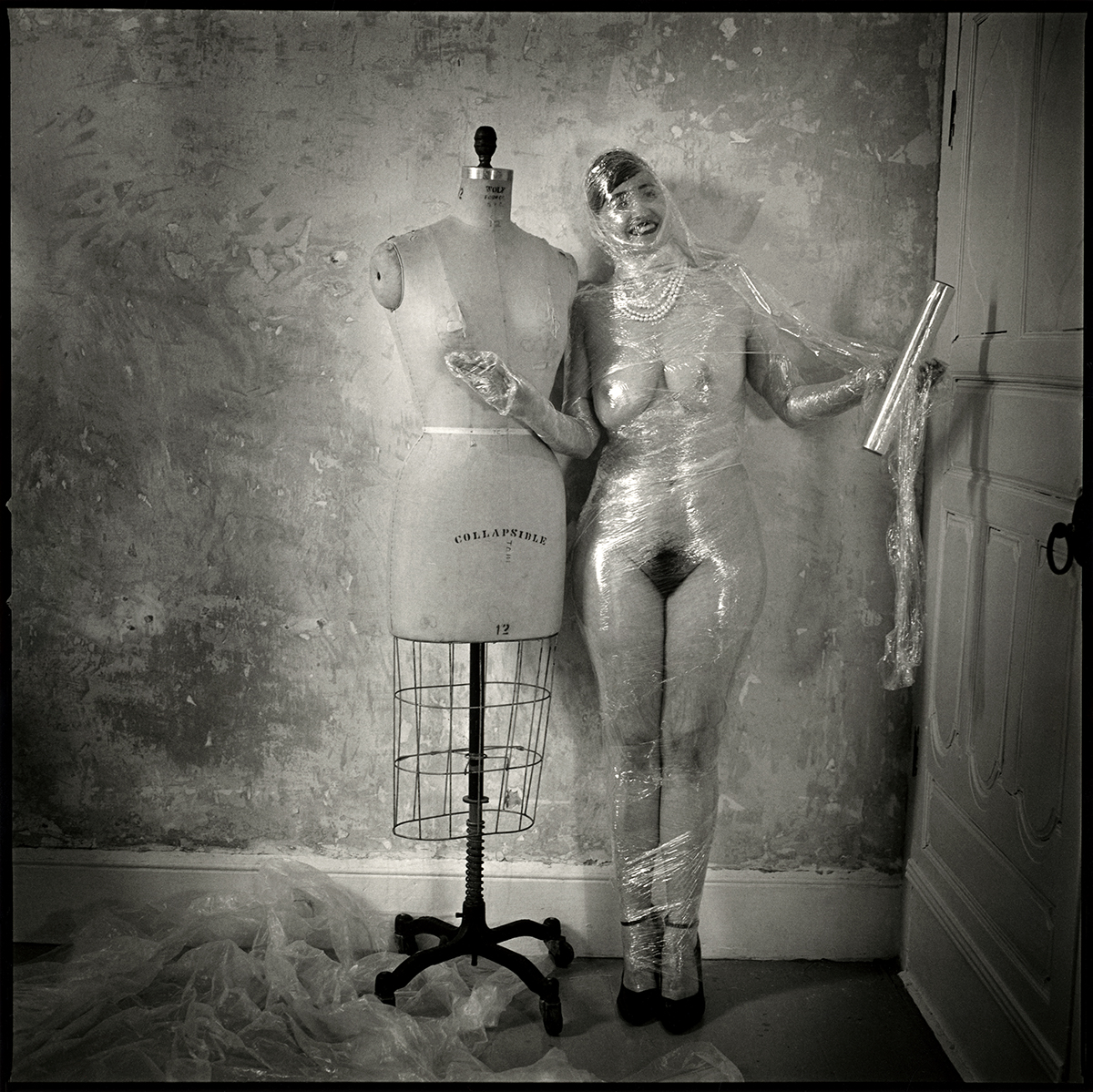

Brittany Markert, Wrapped in Plastic, featuring Angel Monsoon, 2025, silver gelatin print.
You mentioned specific archetypes. Can you elaborate on that?
The most prominent archetypes throughout the series are the shadow, the ego. Recently, I’ve been researching the work of Hilma af Klint, the painter. In her work and spiritualism and the writings of Carl Jung, there are ideas that there are different stages of consciousness. The way I understand it is that the [stages] give you different gifts of sight. You might notice things that are a duality of the ego and the shadow: the higher self, the image, the way people present to the world. You might also be drawn to chaos, or you might understand things in dark versus light, bad versus good, evil versus heroic. That is a universal structure that allures people into horror or storytelling. It’s a simple way to create meaning.
I made my own characters based off these ideas, but it wasn’t that I researched the ideas and then made them. It’s more like I was making them and discovering that Carl Jung had written about it, and then once I read about it, it deepened the way I understood what I was doing. The archetype of dark and light is something I use a lot in my work to explore duality. I think of the archetype of the maiden: the young, innocent woman who enters adulthood and doesn’t know about the forces of darkness, so to speak. The maiden evolves throughout my story.
When I photograph different people, I see them all as the same archetype. Then, they get more complex. I think that, as of last year, I exorcised the woman in black—the shadow—out of my entire world. It’s part of the work itself. This is what Carl Jung would say: if you confront these archetypes and you integrate them, understand them, exorcise them, it changes your clarity on your life and on other people.
I’ve had experiences with a few specific writers where I might not have known about them, or hadn’t been reading them for long, but any time I came back to their work, we were thinking about the same things.
That’s the beauty of art to me. Writers can mirror back something we’ve yet to really metabolize or understand. It’s more common with writing, but that is, in a sense, how I think about my photography. It’s not really a photograph in a traditional sense.
You feel like it’s more part of a story?
Yeah. It functions more like film or literature.

Brittany Markert, A Way Out, featuring Abby Holgerson, 2024, silver gelatin print.
I know you make other types of art, including 16 millimeter film and performance art.
I’m fascinated by different mediums. Photography just came to me the easiest, and I chose to devote myself. I took a class in New York at Mono No Aware. It’s a nonprofit for experimental filmmaking, 16 millimeter. I felt like I arrived at a point where my voice outgrew photography, and filmmaking opens up a lot more, conceptually, for me.
Then the pandemic happened, and I never really figured out a way to survive. Photography, I deeply love it, and I know how to survive from it. Filmmaking, I invested all my own savings into that project, and I will never regret that, but I didn’t recoup anything. It’s something that haunts me, that I hope to figure out a way to get back to. I bought color film four years ago, and it’s been in my closet because I’m scared to use it.

Brittany Markert, The Gift, featuring Abby Holgerson, 2025, silver gelatin print.
You have an upcoming exhibition with Sadie Shoaf. How did that collaboration come about?
Sadie Shoaf’s moniker is Sandy Loaf. We have followed each other for a decade or so. I admire women who are building things. Sadie is constantly making horrifying masks. Her work is horrifying, and she is the sweetest little person in real life. Three or four years ago, I commissioned Sadie to create this archetype for me, the bully. It came out so well. I’m actually horrified of the mask.
This exhibition is an experiment for me. I feel like we’re not necessarily collaborating. We get to be our fullest expressions of ourselves, which is very rare in this world, especially for women artists that are seen as dark or weird or outside of mainstream. I’m going to have large-scale silver gelatin prints, for the first time ever, of my work. Sometimes my work can feel internal and serious and intense, and her work is quite different. It brings out some humor, absurdity, color, and the way that they’ll interact together will create a more vibrant experience of a similar kind of psychic space.
I feel like artists are communicating. Artists need each other. Photography by itself can be quite boring. An image can be impactful, but artists working together can bring a whole space to life. I’m inviting Sadie to show up as her full self. It’s the experience I wish I could have, so I’m happy to give that to other women: “Just come be yourself, be your weirdest self, and show up and let’s have a conversation.” Almost like how musicians play together. I’m excited to see what we do and how we push each other.
Brittany Markert recommends:
Listening to The Caretaker’s An Empty Bliss Beyond This World, on repeat.
Taking the long way home, indulging in the beauty of roads less traveled, and following curiosity without knowing where it will lead.
Initiating a descent into the dark matter of your own subconscious—and the collective shadow—by reading Meeting the Shadow: The Hidden Power of the Dark Side of Human Nature, edited by Connie Zweig and Jeremiah Abrams.
Dining alone at a decadent restaurant, adorned in your favorite outfit, with a pen and journal on the table, just in case.
A hot vinyasa flow class taught by Gabriella Pineda.
- Name
- Brittany Markert
- Vocation
- photographer
Some Things
Pagination